|
Getting your Trinity Audio player ready...
|
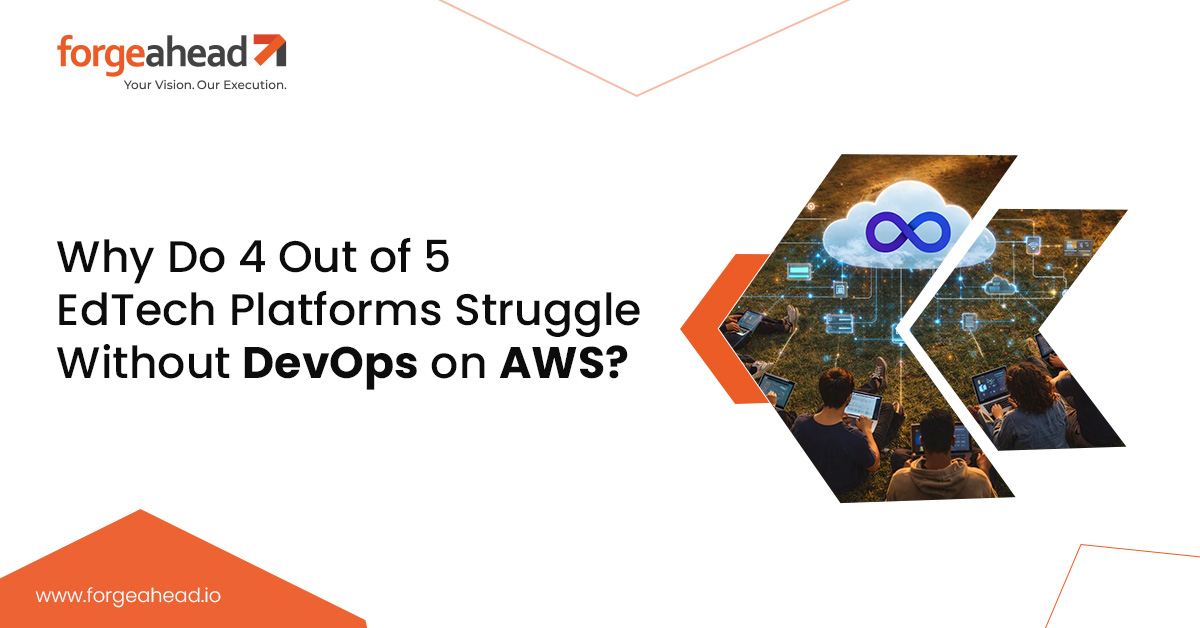
Organizations that follow cloud migration best practices can realize around $1 trillion in business value, yet many EdTech platforms fail to capture this opportunity. As learners demand AI-driven, personalized experiences that work flawlessly at any time, whether exploring an AR science lab in Tokyo or joining a live seminar in London, platform reliability faces constant pressure. Rapid growth exposes performance gaps, and simply running on the cloud cannot handle the spikes during enrollment weeks or finals. Using AWS DevOps services for education helps platforms manage updates, scale efficiently, and prevent technical bottlenecks that threaten the learning experience.
Why do EdTech Platforms Struggle Without DevOps?
Peak usage periods expose operational gaps due to limited automation and disconnected operations, especially when demand surges without warning. Platforms often carry monolithic software practices into cloud environments through this approach, which restricts scale, release speed, and system visibility during critical usage windows.
Common problem areas include:
- Enrollment spikes under load: Auto-scaling gaps cause downtime during peak access windows. During course registration, large login surges overwhelm fixed server capacity, which leads to session drops and administrative delays.
- Slow release cadence: Long deployment cycles make it hard to keep pace with frequent updates in AI-enabled learning tools. As a consequence, manual releases and isolated testing slow feature delivery and increase deployment errors.
- Limited operational visibility: Weak observability delays awareness of performance drops. As latency appears in live collaboration or assessment tools, issues surface only after users disengage.
- Inefficient cloud spend: Cloud usage remains hard to track without automated controls and optimization. Over time, idle resources stay active outside peak academic periods, driving unnecessary costs.
How AWS + DevOps Solves These Problems
Adopting AWS DevOps services reduces manual intervention and brings consistency through code-driven reliability. Through cloud-native architectures, platforms operate as responsive systems that adjust to usage patterns tied to classroom activity.
- Elastic Application Scaling
EdTech platform scalability on AWS is typically handled using services such as AWS Lambda and Amazon ECS or EKS. Each microservice scales independently, which keeps performance stable during demand spikes. For example, a grading service can expand during exam periods while the enrollment portal continues at baseline capacity, controlling cost without affecting availability.
- Predictable Release Execution
Release workflows improve through CI/CD pipelines powered by AWS CodePipeline. Deployments become routine rather than high-pressure events. Organizations using these pipelines restore failed services in under a day and keep change failure rates below 15 percent, based on recent DORA metrics.
- Built-in Operational Visibility
Operational awareness improves through observability tools like Amazon CloudWatch and AWS X-Ray. These services surface performance issues early, which helps engineers address latency in AI-driven learning features before it affects student time to first success.
- Security Embedded in Delivery
Security-first DevOps practices automate compliance with FERPA and GDPR. Encryption, auditing, and access controls stay enforced while development velocity remains steady.
The Role of Agentic AI in DevOps
Agentic AI acts as an autonomous teammate in DevOps workflows, managing operations with intelligence instead of following a rigid script.
- Real-time monitoring and response: On learning platforms, agents track system health and respond to intent. When traffic surges on an AR/VR simulation, the AI can provision additional capacity, optimize database queries, and adjust minor code issues automatically.
- Productivity and recovery gains: AI-assisted operations help teams increase productivity and reduce the Mean time to recovery (MTTR), keeping services available during peak usage.
- Self-healing infrastructure: Combining agentic AI with AWS creates infrastructure that adapts dynamically to student activity, therefore minimizing downtime and addressing performance bottlenecks proactively.
Forgeahead’s Strategy for High-Performance EdTech Platforms
High-performance learning platforms succeed when legacy systems are transformed into cloud-native, scalable platforms. Forgeahead gives EdTech platforms the AI-native edge, helping them achieve faster results with modernization, AWS DevOps, and agentic AI working together.
- Modernization: Legacy platforms are refactored into microservices-based architectures. Agentic AI assists with testing, optimization, and performance tuning to ensure smooth operations at scale.
- DevOps Competency: End-to-end CI/CD pipelines and observability frameworks improve cloud reliability issues in EdTech. Platforms stay resilient and responsive even during peak academic periods.
- Global Efficiency: AWS’s worldwide infrastructure delivers low-latency experiences to learners, no matter where they are located.
The approach lets educational providers concentrate on pedagogy and learning outcomes while Forgeahead manages the engineering that keeps the platform seamless, scalable, and ready for high-demand periods.
Creating Resilient Platforms for Education
Reliability shows that learners can access and use a platform smoothly, every time. Platforms that implement DevOps on AWS and agentic AI maintain smooth operations even during peak demand. Forgeahead helps platforms scale efficiently, maintain performance under pressure, and deliver consistent, high-quality learning experiences globally.
Is your platform ready to scale without disruption? Connect with Forgeahead today to see how DevOps on AWS can modernize your platform.
FAQs
It uses Infrastructure as Code (IaC) to auto-scale servers in seconds during traffic surges and scale down during low usage.
Standard automation follows fixed rules, while agentic AI understands goals and makes decisions to maintain performance automatically.
Forgeahead provides engineering expertise to optimize performance, reliability, and deployment workflows for growing platforms.
AWS provides secure infrastructure and tools like IAM and Artifact to automate encryption, access control, and audit logging.
Observability traces requests through AI models, revealing where delays occur beyond just server uptime