
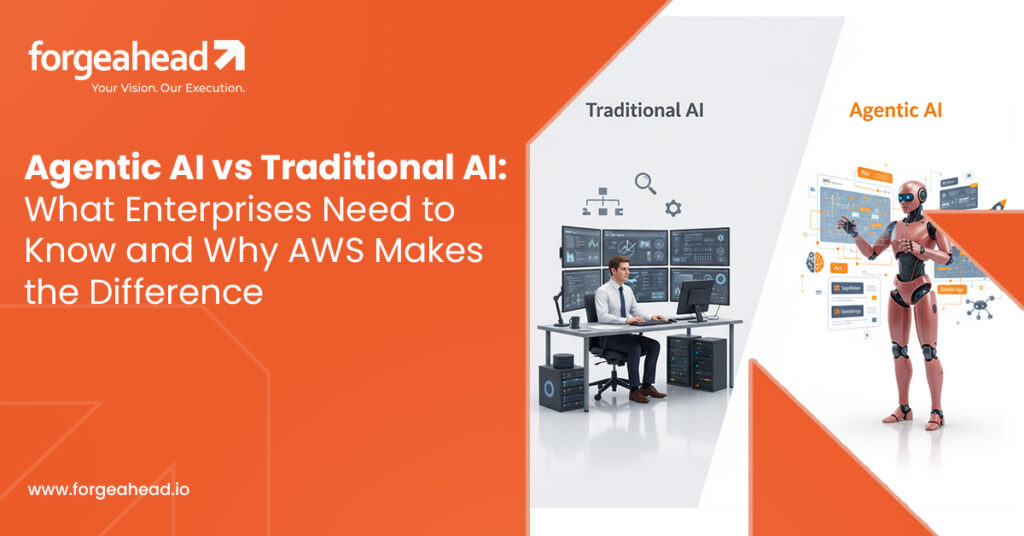
As artificial intelligence (AI) evolves, a fundamental shift is underway; from traditional, narrowly scoped models to agentic AI systems capable of autonomous, goal-driven behavior. For enterprises, this isn’t just a technological nuance. It’s a strategic inflection point. Understanding the difference between traditional AI and agentic AI is essential for leaders looking to future-proof their digital transformation efforts and to choose the right cloud ecosystem.
In this blog post, we will explore what sets agentic AI apart from its predecessors and examine its implications for enterprise deployment. We’ll also look at how AWS is uniquely positioned to help organizations operationalize this new paradigm on a scale.
Traditional AI: Powerful but Passive
Traditional AI, which includes machine learning (ML) and deep learning models that excels at narrow tasks. These models require:
- Static objectives: A supervised model trained to classify images or detect fraud works within the strict bounds of its training data and objectives.
- Extensive human supervision: Pipelines must be carefully curated by data scientists and engineers. There’s limited ability to adapt in real-time.
- Orchestration complexity: To perform multi-step tasks, models need external orchestration. Done typically via hard-coded scripts, decision trees, or APIs.
While immensely valuable, traditional AI solutions are passive. They wait for inputs, process them according to trained patterns, and return outputs. Enterprises looking to scale AI often struggle with:
- Fragmented workflows across data ingestion, inference, and action.
- Rigid models, unable to handle dynamic goals or evolving environments.
- High engineering overhead to maintain performance at scale.
Agentic AI: Autonomous, Context-Aware, and Goal-Oriented
Agentic AI represents a leap beyond narrow, pre-scripted models. Inspired by the concept of intelligent agents, these systems can:
- Set and pursue goals autonomously.
- Iteratively plan, execute and adapt based on real-time feedback.
- Coordinate multiple tools, APIs, and models to complete complex workflows.
Imagine an enterprise AI agent that can handle a customer support ticket from end to end. Further identifying the issue, querying internal systems, communicating with the customer, and escalating only when necessary, all without predefined paths. This is agentic AI in action.
Key Characteristics
| Feature | Traditional AI | Agentic AI |
| Autonomy | Low | High |
| Adaptability | Limited | Dynamic & contextual |
| Task Scope | Narrow/specific | Multi-step & open-ended |
| Tool Use | Static APIs | Dynamic tool invocation |
| Feedback Integration | Post-hoc retraining | Real-time reasoning & adaptation |
Agentic AI shifts the paradigm from ‘model-as-a-function’ to ‘AI-as-a-worker’ capable of reasoning, planning, and acting in complex environments.
Why This Matters to Enterprises
The enterprise implications of agentic AI are profound, here are some:
- Exponential Productivity Gains: Agentic systems can automate multi-step business processes. Right from procurement to customer onboarding to further reducing the need for human intervention across repetitive, knowledge-intensive tasks.
- More Resilient Decision-Making: Unlike static models, agentic AI can ingest new information in real time, adjust strategies, and learn from outcomes, increasing the robustness of automated systems in volatile environments.
- Lower Total Cost of Ownership: By reducing the number of point solutions and eliminating extensive orchestration logic, agentic systems simplify architecture and reduce long-term operational costs.
The AWS Advantage: Building Enterprise-Grade Agentic AI
While many platforms are racing to integrate agentic capabilities, AWS offers a uniquely enterprise-ready ecosystem that balances innovation, scalability, and control.
- Foundational Models with Flexibility: With Amazon Bedrock, enterprises can access leading foundation models (Anthropic, Meta, Mistral, Cohere, and more) via a single API, making it easy to test and integrate agentic capabilities without vendor lock-in.
- Agents for Amazon Bedrock: Launched in 2023, Agents for Amazon Bedrock allow developers to build goal-driven AI agents that can:
- Plan tasks based on natural language input.
- Dynamically invoke APIs or call AWS Lambda functions.
- Handle multi-turn interactions and tool use seamlessly.
Unlike custom orchestration stacks, this is fully managed, enabling rapid prototyping and deployment at scale.
- Integrated Security and Governance: Enterprises can leverage Amazon SageMaker, IAM, CloudTrail, and Guardrails for Bedrock to build responsible agentic AI solutions with:
- Fine-grained access control.
- Activity logging and compliance reporting.
- Guardrails for safety, bias mitigation, and content filtering.
- Seamless Data and App Integration: From Amazon Aurora to Step Functions, agentic AI agents can integrate with the broader AWS ecosystem to operate across your enterprise stack; securely and natively.
Use Cases Emerging in the Enterprise
Here are a few enterprise-grade use cases AWS is enabling with agentic AI:
- Automated compliance workflows: AI agents that monitor regulatory updates, audit internal processes, and flag deviations in real-time.
- Procurement optimization: Agents that autonomously gather quotes, evaluate suppliers, and generate purchase orders; all while learning from outcomes.
- Software engineering copilots: Integrated with CodeWhisperer and Bedrock Agents, enabling agents that not only write code but test, deploy, and document it autonomously.
- Customer service agents: Multi-lingual, goal-directed agents that handle tickets end-to-end across channels, with human-in-the-loop escalation.
Preparing for the Agentic Future
Enterprises that want to embrace agentic AI should focus on:
- Re-architecting for autonomy: Design workflows not just as chains of tasks, but as goal-oriented interactions between agents and systems.
- Investing in prompt and agent design: This includes system instructions, tool specifications, memory handling, and context grounding.
- Establishing governance and safety protocols: Leverage AWS tools for monitoring, auditing, and enforcing ethical AI behavior.
Conclusion
Agentic AI isn’t just the next generation of AI, it’s a new operational model for the enterprise. Moving beyond passive inference toward autonomous, intelligent action has the potential to reshape how organizations innovate, compete, and serve customers. AWS is at the forefront, offering scalable agentic tooling, secure infrastructure, and enterprise-grade integrations. As a result, businesses have everything they need to harness the promise of agentic AI today.