|
Getting your Trinity Audio player ready...
|
Fewer than 10% of enterprises have successfully scaled agentic AI, even as experimentation continues to grow across organizations. This divide highlights how early-stage adoption is still finding its footing when it comes to real execution at scale. Agentic AI is increasingly used in business processes where systems handle multi-step tasks across applications and workflows. Integrating these systems into established environments brings added complexity, especially when legacy tools and governance structures are already in place. Introducing autonomous execution requires a structured approach that supports reliability, control, and consistent performance across workflows.
This blog on agentic AI in business processes covers integration practices, governance, deployment challenges, and scaling strategies for reliable enterprise adoption.
What Agentic AI Brings to Business Processes
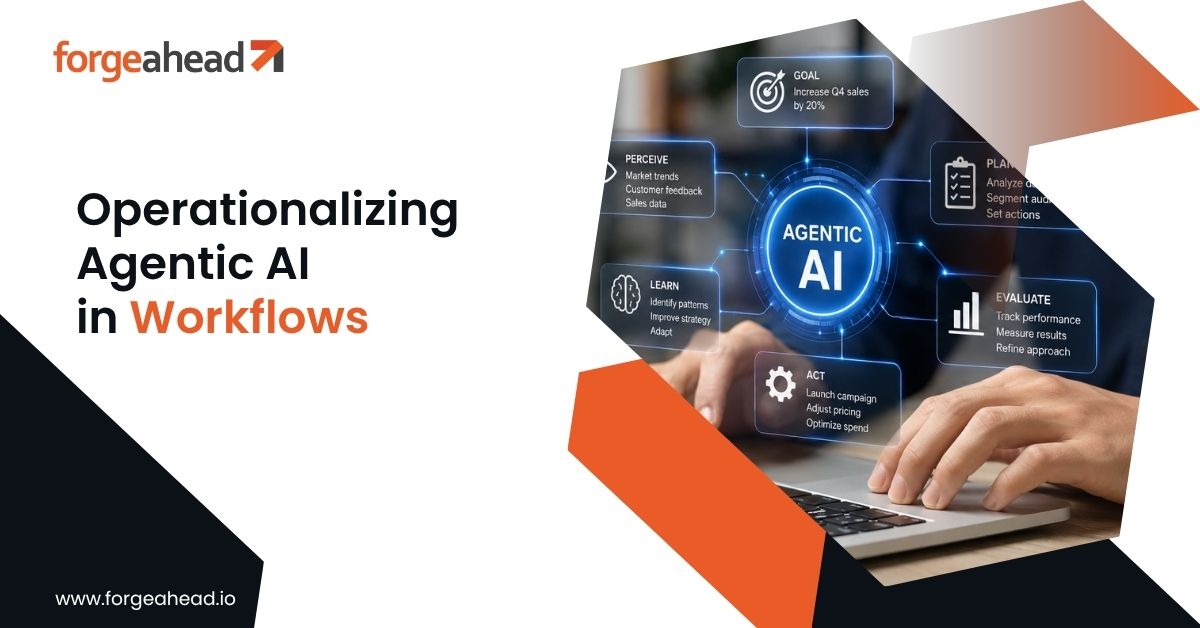
Agentic AI works through systems that perceive context, reason through inputs, and use tools with limited human supervision. Traditional automation often relies on fixed rules, while these systems handle multi-step goals and adjust actions based on changing conditions during execution.
In practical workflows, these agents operate as an execution layer across existing applications. Tasks such as supply chain reconciliation or customer support coordination across multiple channels run through direct interactions with ERP, CRM, and communication platforms. As execution continues across systems, decisions stay aligned with outcomes in high-volume workflows, which supports consistency across connected processes.
Why Integration Into Existing Systems Is Complex
Despite strong interest, nearly two-thirds of enterprises have not yet begun scaling AI across the organization, even though adoption is widespread . The difference between adoption and execution reflects how enterprise environments are structured. Legacy systems and modern cloud tools often run in separate layers, while business processes span multiple interconnected applications.
Introducing agents into these environments brings added risk.
- Uncontrolled Actions: Agents may trigger financial or data-altering transactions without proper oversight.
- Observability Gaps: Tracing decisions across multiple API calls becomes difficult when actions span systems.
- Integration Overhead: Connecting agents with legacy APIs while maintaining data quality and compliance requires significant engineering effort.
Without alignment between AI behavior and business rules, autonomous execution can lead to outcomes that are difficult to manage within existing operational structures.
What Are the Best Practices For Deploying AI Agents In Enterprises?
To move from pilot to production safely, organizations follow a structured approach that keeps control intact while preserving agent utility.
- Start with Well-Defined Workflows: Focus on repetitive, high-volume tasks where outcomes are measurable. Narrow use cases help maintain control, and a single-agent setup is used by 58% of the market because it is easier to manage and secure.
- Embed Governance via Identity for Every Agent: Assign each AI agent a unique identity. This enables clear audit trails where every update links directly to a specific agent action instead of a generic system event.
- Implement Least-Privilege Access: Apply role-based access control so agents interact only with the systems and data required for their assigned task. This reduces unnecessary exposure across connected applications.
- Design for Human + Agent Collaboration: Keep human involvement in high-stakes actions. An agent can prepare a $50,000 purchase order while final approval remains manual. Studies show that collaborative workflows deliver significantly higher productivity compared to human-only setups.
The Role of Data, APIs, and Workflow Orchestration
Agentic AI depends heavily on the quality of data access and the tools available for execution. Secure integration patterns connect agents with enterprise systems in a controlled and consistent way. At the same time, standards such as the Model Context Protocol (MCP) are gaining adoption for enabling secure and standardized connections between agents and external data sources.
APIs serve as the execution layer that allows agents to interact with applications and services. Workflow orchestration coordinates these interactions so actions follow defined business logic across steps. A modular architecture supports reuse of workflow components, which helps extend agentic capabilities across different functions without rebuilding integrations each time.
How AI Improves Business Process Efficiency
Agentic AI integrated into structured business workflows improves operational productivity across functions. AI-assisted development shows up to 30% reduction in effort for repetitive engineering activities. AI-enabled delivery pipelines also reduce testing and release cycle effort significantly depending on the level of workflow automation.
As repetitive execution reduces, attention across engineering and delivery shifts toward higher-value work such as planning and decision-making. Strong data foundations and well-integrated systems play a major role in this outcome. Organizations with higher AI readiness report financial performance that is 7.2 times stronger compared to peers with lower readiness levels.
How Forgeahead Enables Agentic AI Integration
Forgeahead focuses on how AI modernization takes shape in real systems. We integrate agentic AI in business processes by reworking legacy architectures into cloud-native environments that support agent-ready execution. AWS-native GenAI capabilities help us build secure, scalable, and observable agentic layers that connect with existing systems instead of operating in isolation.
Our experts design product engineering pods to run workflow automation where agentic AI in business processes connects directly with codebases, test pipelines, and deployment systems. We apply automation across code analysis, testing, and modernization so execution stays consistent across legacy and cloud-native environments. These workflows support agentic orchestration in real delivery systems using AWS-native services and structured integration practices.
Conclusion
Integrating agentic AI takes sustained effort across systems, workflows, and governance. Balance between autonomy and control shapes how reliably agents operate within structured, observable environments. As adoption matures, organizations that treat agents as part of everyday digital operations build stronger execution efficiency and adaptability over time.
Ready to move AI agents from experimentation to production use? Talk to Forgeahead to explore how engineering pods integrate agentic AI in business processes and improve execution speed across workflows.
Frequently Asked Questions
Scaling too quickly without governance, identity control, or least-privilege access
Agentic AI enhances RPA by adding decision-making ability for handling exceptions and unstructured inputs.
Action guardrails and human approval steps restrict agents from executing irreversible operations.
MCP is a standard that enables secure and consistent access to external data and tools for AI agents.
Basic implementations can take around 90 days, while complex multi-agent setups may require longer timelines.