|
Getting your Trinity Audio player ready...
|
78% of organizations continue to increase investment in AI, which reflects a clear push toward systems that can operate with more intelligence and speed across core digital workflows. Even with this momentum, the digital experience layer still struggles to keep pace with rising expectations for 4K streaming, real-time personalization, and seamless omnichannel delivery. Agentic AI on AWS is emerging as a key enabler in this space, where automation and execution intelligence come together to support large-scale transformation work.
Many enterprises remain tied to legacy or semi-modern CMS platforms that slow down content operations and limit adaptability. These systems often require high maintenance effort and delay how quickly content changes reach users, which makes them less suited for modern digital delivery needs.
CMS migration has traditionally required long timelines and heavy coordination. This often results in systems going live after market needs have already evolved. Modernization now focuses on rebuilding content systems for speed, intelligence, and autonomous operation rather than only relocating existing setups to new infrastructure.
Why CMS Modernization Slows Down in Practice
CMS modernization rarely slows because of intent since legacy monolith architectures carry most of the weight. These systems hold tightly coupled templates and content layers where even small changes ripple across the setup.
Content modeling and migration bring in heavy manual effort as old structures need to be mapped to newer models with care. SEO structures require precision to avoid disruption while existing publishing workflows depend on stable integrations that are difficult to untangle. As a result, engineering capacity is often spent on keeping the current systems stable, which leaves limited room for larger architectural changes.
Cloud migration alone does not resolve these constraints since hosting the same architecture in a cloud environment keeps the same limitations in place. What matters here is a redesign of how content systems are structured and how they operate across environments.
Best AWS Architecture for Modern CMS Platforms
A foundation designed for speed becomes essential when CMS modernization needs faster execution. AWS serves as that base layer for content-heavy systems where modular design supports modern requirements.
A strong AWS architecture for modern CMS platforms typically includes:
- Serverless compute: AWS Lambda handles content processing without server management
- Managed databases: Amazon Aurora and DynamoDB support scalable, high-performance content storage
- Event-driven pipelines: Amazon EventBridge triggers content updates across multiple channels in real time
This setup supports a decoupled, cloud-native CMS that handles scale across geographies while maintaining security and governance controls. AWS provides the underlying infrastructure and building blocks for this kind of system. Yet, the actual construction work around migration and refactoring still depends heavily on human effort and manual coordination.
The execution layer carries most of the constraint since complexity slows how modernization is carried out.
Agentic AI on AWS for Faster CMS Modernization
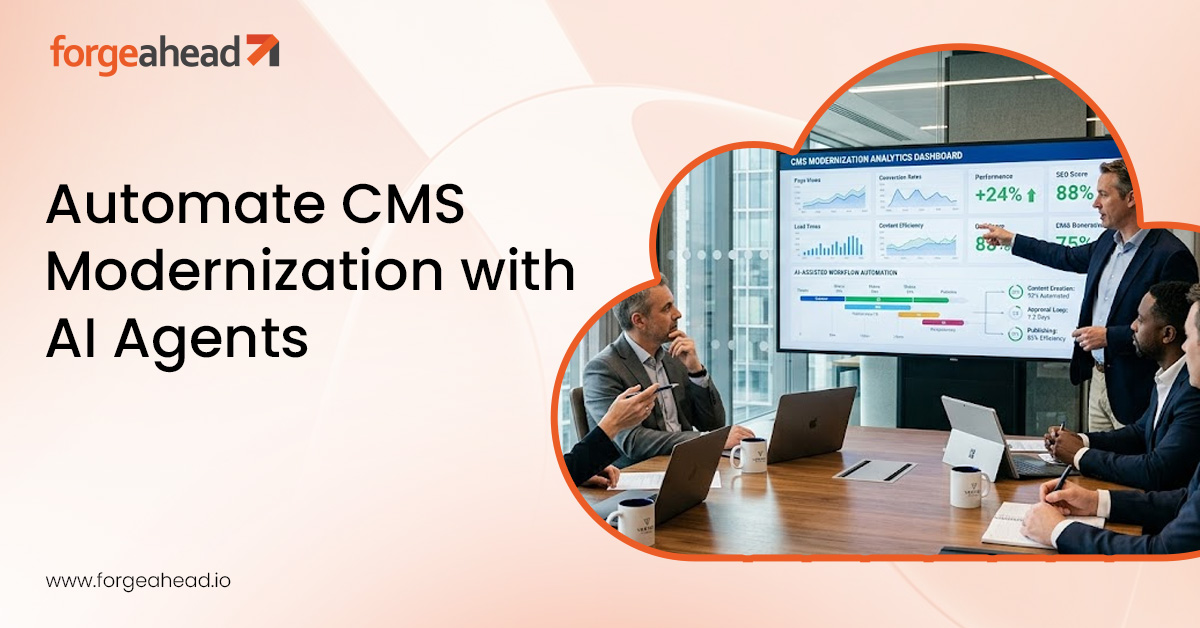
Agentic AI on AWS adds a different layer of capability to CMS modernization. Standard generative AI mainly focuses on producing responses. Agentic AI works through planned steps, carries out tasks, and adjusts the approach as work progresses across different workflows. In CMS modernization, these systems act like engineering copilots that support transformation work.
Instead of manually mapping thousands of legacy content nodes to a new schema, AI agents for CMS workflows take on parts of the analysis and execution:
- Structure analysis: Reviews existing CMS setups and identifies hidden dependencies across templates, APIs, and databases.
- Content mapping: Aligns content models with modern headless architectures with higher precision.
- Migration planning: Builds migration paths and supports refactoring of legacy components.
- Testing automation: Creates test cases to validate SEO consistency and functional parity after migration.
Additionally, these agents operate within controlled enterprise environments where workflows, security rules, and validation steps remain defined.
Industry expectations point toward noticeable gains in software engineering productivity through GenAI-driven automation. When combined with AWS-native services, agentic AI supports faster modernization cycles by reducing manual coordination and accelerating execution across modernization workflows.
What Fast CMS Modernization Looks Like in Practice
When you modernize legacy cms with ai, the process follows a continuous, agent-assisted pipeline instead of a single large-scale effort. A fast-track approach typically follows this flow.
- Automated discovery: AI agents scan the legacy environment and map dependencies across templates, APIs, and content structures.
- Incremental migration: Features and content blocks move in stages while the existing system continues to run, which helps maintain stability during change.
- Continuous validation: Testing agents run throughout the process and check each migrated element against the original setup to maintain consistency.
- Observability-driven deployment: AWS-native services host the updated system with real-time monitoring, and agents track performance while suggesting adjustments based on system behavior.
Workload around manual coordination reduces as automation takes on repetitive parts of the process. Migration paths become easier to manage, and execution stays steady across cycles.
Risks of Not Modernizing with a Structured Approach
Staying on legacy systems creates long-term pressure on both cost and performance. As systems age, complexity builds up and makes later changes harder to manage.
- Growing technical debt: Each additional year on legacy systems increases the effort required for any future change, as dependencies expand and systems become harder to untangle.
- Missed personalization capability: Legacy setups limit access to real-time data processing, which reduces the ability to deliver relevant, context-aware content experiences.
- Slower experimentation cycles: Limited ability to test and release new content features reduces the pace of iteration and delays validation of new ideas.
How Forgeahead Enables Fast CMS Modernization
Forgeahead brings together AWS-first engineering and Agentic AI to support software modernization that focuses on business value rather than infrastructure-only changes. Agentic AI systems handle migration analysis, code refactoring, and structured testing, which reduces manual effort and improves execution speed across modernization work.
Our modernization work centers on reshaping monolithic applications into modular, cloud-native structures. Forgeahead also provides engineering execution support that scales delivery capacity, where AI-assisted workflows and AWS-native services work together to support faster and controlled system evolution.
Conclusion
A CMS no longer stays static after setup since it evolves along with business needs. AWS, Agentic AI, and modern engineering practices support continuous modernization that keeps systems aligned with changing requirements and reduces reliance on large, disruptive upgrade cycles. CMS platforms built this way adapt faster and stay easier to extend over time.
Are you ready to stop managing your legacy CMS and start innovating? Contact Forgeahead today to learn how our Agentic AI-powered pods can modernize your CMS on AWS at record speed.
Frequently Asked Questions
1. How does Agentic AI differ from standard Gen AI for migration?
It manages migration end to end by planning, executing content movement, running tests, and fixing issues during the process.
2. Is data secure when using AI agents on AWS?
AI agents run inside secure AWS environments using services like Amazon Bedrock and PrivateLink, keeping proprietary data within the system.
3. Can CMS modernization happen without downtime?
Yes, a Strangler Fig approach allows gradual migration where legacy features are wrapped and replaced in stages without taking systems offline.
4. How much time does AI-assisted modernization save?
Discovery and early refactoring phases typically complete faster than manual methods, reducing effort across initial modernization stages.5. Does this work for custom-built CMS platforms?
Yes, AI agents adapt to custom-built systems by analyzing existing patterns even when documentation is limited.