|
Getting your Trinity Audio player ready...
|
Deloitte’s Tech Trends 2026 research found that 71% of surveyed organizations are modernizing core infrastructure to support AI implementation. Legacy .NET applications present a significant challenge in this shift. Many still run on .NET Framework, which receives security and reliability updates rather than new features. Years of patches and workarounds accumulate technical debt, while monolithic architectures often require larger servers to handle growing workloads. Aging libraries can increase security risks, and licensing fees combined with specialist maintenance can drive up operational costs.
What Does .NET Application Modernization Involve?
The work behind .NET application modernization covers four levels of change, and most applications need only one or two.
- Framework upgrade: Upgrade code on .NET Framework to current cross-platform .NET with minimal functional change.
- Refactoring: Restructure code, separate concerns and expose functions through APIs.
- Replatforming: Run the application on containers or managed services with limited code change.
- Rearchitecting: Split a monolith into services where scale or release speed demands it.
.NET modernization rarely requires rewriting the entire application. A stable reporting module may need only an upgrade, while a bottleneck in order processing may justify rearchitecting.
How .NET Transformation Helps Modernize Legacy Applications for the Cloud
To transform .NET applications for the cloud, the process usually runs in four stages.
- Assess dependencies: Inventory libraries, Windows-only APIs, databases and integrations to see what blocks portability.
- Update components: Port code to current .NET and replace unsupported packages. AWS Transform for .NET automates much of this by analyzing repositories, proposing a plan for human approval, converting code and running unit tests. AWS reports porting up to four times faster than manual work, a vendor figure worth testing on one application first.
- Modernize the data layer: Move SQL Server workloads toward managed engines such as Amazon RDS or Amazon Aurora where licensing and scale demand it.
- Prepare for deployment: Validate Linux readiness, containerize the application and add pipelines so releases are repeatable.
How to Transform Legacy .NET Applications for Cloud-Native Environments
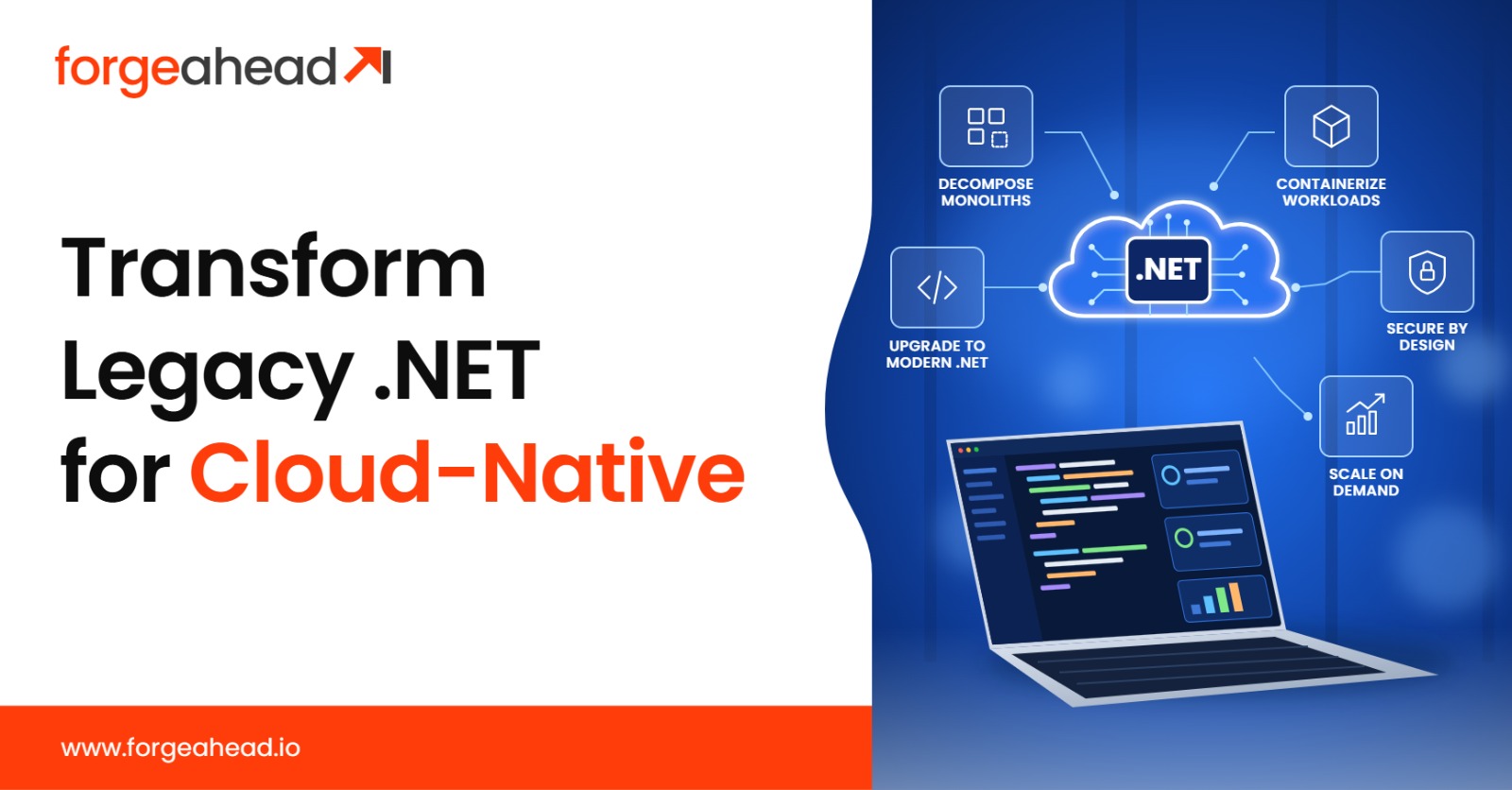
Cloud-native .NET applies different patterns to different workloads, and each pattern should earn its place.
- Containers: Package ported applications for Amazon ECS or Amazon EKS so releases behave the same in every environment.
- APIs: Wrap business logic with Amazon API Gateway so other systems and AI agents can call it.
- Managed databases: Replace self-managed SQL Server with Amazon RDS or Aurora to reduce patching and backup work.
- Serverless services: Run event-driven jobs on AWS Lambda, which supports .NET.
- Microservices: Extract only the modules that need independent scaling.
Consider a typical modernization path on AWS. A .NET Framework web application running on a Windows EC2 instance can be modernized to .NET 8 using AWS Transform, then containerized and deployed to Amazon ECS on AWS Fargate, with its database hosted on Amazon RDS. According to AWS, eliminating Windows licensing dependencies can reduce operating costs by up to 40%, although actual savings depend on the application architecture, licensing requirements, and migration approach.
How to Reduce Risk During .NET Cloud Migration
A .NET cloud migration carries less risk when each step has a check attached.
- Planning and compatibility checks: Scan for unsupported APIs and package gaps before any code moves.
- Automated testing: Build regression suites around current behavior and run them on every change.
- Security: Apply least-privilege IAM roles, encryption and dependency scanning from the first deployment.
- Phased cutovers: Shift traffic gradually, one module or user group at a time.
- Rollback and performance validation: Keep the old version running until load tests confirm that response times and error rates match the baseline.
How Can Forgeahead Help Modernize Legacy .NET Applications for AWS?
Forgeahead follows a structured modernization approach that combines application assessment, AI-assisted transformation, cloud-native development, and managed operations to help enterprises reduce technical debt and build scalable, secure applications on AWS.
- Structured Assessment and Modernization Roadmap
We assess application dependencies, architecture, data integrity, and technical debt before selecting a modernization strategy, prioritizing each engagement by business value and risk to minimize disruption and guide implementation decisions.
- AWS Transform for .NET Modernization
For legacy .NET Framework applications, we assess dependencies, then use AWS Transform to accelerate code transformation and migration to modern .NET versions, improving maintainability and identifying opportunities to reduce Windows licensing costs.
- Cloud-Native Architecture and Application Refactoring
Our modernization approach breaks down monolithic applications into modular, cloud-ready architectures, improving maintainability and scalability while preparing applications for future integrations and AI-enabled capabilities.
- Serverless and Container-Based Deployment
Using AWS Lambda for event-driven workloads and Amazon ECS on AWS Fargate for containerized applications, we build deployment architectures that scale with demand while reducing the operational overhead of managing underlying infrastructure.
- DevOps and Automated Delivery
Our DevOps practice combines Infrastructure as Code, CI/CD pipelines, and automated testing to make software delivery faster and more repeatable, reducing manual intervention and improving release consistency across environments.
- Managed Operations and Continuous Optimization
Through ongoing monitoring, incident management, and performance optimization, we help maintain application reliability after migration, using Amazon CloudWatch for operational visibility and AWS CloudTrail for auditing and security investigations.
Conclusion
Legacy .NET modernization pays off when each application gets the level of change it needs, backed by testing and phased cutovers. That approach builds cloud readiness and shortens the time needed to release changes. Which of your .NET applications should move first? Speak to Forgeahead’s experts or explore our AWS application modernization services.
Frequently Asked Questions
1. Why should businesses transform legacy .NET applications?
Older .NET Framework applications carry rising security, scaling and maintenance costs that modern cross-platform .NET and managed AWS services reduce.
2. What is involved in .NET application modernization?
It covers framework upgrades, refactoring, replatforming and, where justified, rearchitecting, chosen per application.
3. How can legacy .NET applications be migrated to the cloud?
Assess dependencies, port the code, modernize the data layer, then deploy in phases with automated testing and a rollback plan.
4. What are some effective strategies for modernizing legacy systems?
Wrap legacy functions with APIs first, then upgrade or extract only the components that limit scale or speed.
5. What are the benefits of transforming .NET applications?
Lower licensing and upkeep costs, better scalability, stronger security and faster release cycles.
6. How can businesses determine whether to refactor, replatform, or rebuild legacy .NET applications?
Weigh each application’s business value, code condition and dependency risk, and rebuild only where lighter options cannot meet the need.