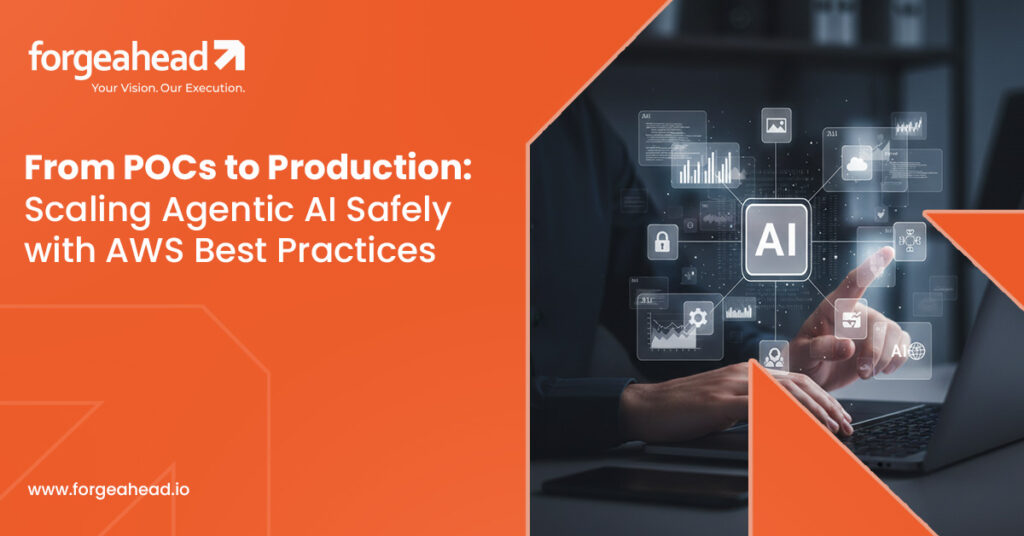
According to Grand View Research, Inc, the autonomous AI and agents market is booming and is expected to hit USD 70.53 billion by 2030. Agentic AI holds the potential to act independently and achieve complex goals. We’re seeing groundbreaking Proof of Concepts (POCs) emerge daily, showcasing incredible capabilities. However, there’s a big difference between an exciting POC and a robust, secure, and scalable production deployment.
This blog will guide you on how to scale Agentic AI and move your initiatives from experimental POCs to reliable production systems. We’ll explore how leveraging AWS best practices provides the security, scalability, and observability needed to realize the full potential of Agentic AI on AWS
From POC to Production Readiness
The transition from a successful POC to a production-ready Agentic AI system requires a major shift in mindset and strategy.
A. The POC Phase
The focus of the POC phase is on rapid prototyping, validating the core concept, and deciding whether your Agentic AI idea is feasible. POCs are usually smaller in scale and require human supervision. There is less emphasis on enterprise-grade security, robustness, and cost efficiency. A common pitfall of this phase is getting stuck and being unable to move beyond the experimental stage. This happens when you underestimate the complexity of a real-world production environment.
B. Shifting to a Production Mindset
You need to adopt a rigorous production mindset to move beyond the POC. The focus shifts to:
- Reliability: Ensuring the agent performs consistently and predictably.
- Security: Protecting sensitive data and preventing unauthorized actions.
- Scalability: Handling fluctuating workloads and increasing user demand.
- Observability: Gaining deep insights into agent behavior, performance, and issues.
- Cost-Efficiency: Optimizing resource consumption for sustainable operation.
- Governance: Establishing clear policies and ethical guidelines for autonomous systems.
Scaling Agentic AI Safely with AWS Best Practices
AWS offers a wide range of services that address the challenges of scaling Agentic AI solutions.
A. Secure Infrastructure & Data Handling
Security is of the utmost importance when dealing with autonomous agents. The following practices help establish a secure environment for deploying and managing autonomous agents while protecting sensitive data and ensuring compliance:
- Network Isolation: Utilize the AWS Virtual Private Clouds (VPCs), subnets, and security groups to create isolated and controlled environments where you can deploy your agents.
- Identity & Access Management (IAM): Use IAM roles to follow the principle of least privilege for your agents and the AWS services they access. Grant only the necessary permissions to your agents and prevent them from performing unintended actions.
- Data Encryption: Make sure all the sensitive data that the agents use or generate is encrypted, both when it’s stored and when it’s being transferred.
- Secrets Management: Use AWS Secrets Manager to securely store and retrieve the API keys, credentials, and other sensitive information.
- Data Governance & Auditing: Use services such as AWS Lake Formation and AWS Glue to manage data governance, ensure data quality, and enforce access controls. Additionally, AWS CloudTrail records an unchangeable log of all the API calls, which supports security auditing and compliance efforts.
B. Scalable & Resilient Deployment
To handle the dynamic nature of agent workloads, it’s important to leverage AWS services that offer the following capabilities:
- Flexible Compute Choices:
- Amazon EC2, ECS, or EKS: These services are great for running custom agent environments, containerizing components, and managing complex multi-agent systems with detailed control.
- AWS Lambda: It works well for lightweight, stateless agent tasks or event-driven actions, with automatic scaling and pay-per-execution billing.
Amazon SageMaker: This service offers an easy way to deploy large language models (LLMs) and other foundational models as scalable, low-latency endpoints for your agents to use.
- Auto Scaling: Implement Auto Scaling groups for EC2, or use the built-in scaling features of ECS, EKS, and Lambda to automatically adjust resources based on the agent demand. This helps in maintaining the performance of the applications and controlling the costs.
- Load Balancing: Apply Application Load Balancers (ALB) or Network Load Balancers (NLB) to evenly distribute the traffic across agent instances, therefore avoiding bottlenecks and improving the response times.
- High Availability: Ensure your agents stay online during outages by deploying them across multiple Availability Zones (AZs) or Regions to increase the system’s fault tolerance and reliability.
C. Monitoring, Observability & Governance
To maintain control and ensure the agent operations are trustworthy, it’s necessary to implement the following practices:
- Comprehensive Logging & Metrics: Use Amazon CloudWatch to gather detailed logs and performance data, such as errors and use of resources, to understand how your agents are working.
- Distributed Tracing: AWS X-Ray lets you see the full path of an agent’s actions across services and tools, making it easier to find and fix issues.
- Model Monitoring: Amazon SageMaker Model Monitor helps detect changes or problems in your models, such as data shifts or biases, to keep them accurate and unbiased.
- Auditing & Compliance: AWS CloudTrail records all the API activity for security checks, whereas AWS Config helps review and manage your AWS settings.
- Responsible AI & Guardrails: Set up strong safety checks such as human review for important decisions, content filters, explainability tools, and clear ethical rules for your agents’ behavior.
D. Data Management for Agent Memory & Context
To help agents remember and use information effectively, you need to have reliable storage and smooth data management processes in place:
- Scalable Storage: Use Amazon S3 to store large amounts of data, such as conversation history and learned info. For structured data, use Amazon DynamoDB (NoSQL) or Amazon RDS (relational database).
- Data Pipelines: Manage how the data moves and gets processed using AWS Glue (for data extraction and transformation) and AWS Step Functions (to control complex workflows).
E. Cost Optimization
Running complex AI agents can be expensive if not managed carefully. To keep expenses under control, it’s important to optimize your computing resources and regularly review your costs:
- Right-sizing Compute: Regularly check how much computing power you’re using and adjust your EC2 instances, ECS tasks, or EKS pods to match the actual demands.
- Pricing Models: Use Reserved Instances or Savings Plans for steady workloads to reduce the compute costs.
- Spend Monitoring: Use AWS Cost Explorer and other tools to track your expenses closely and find ways to reduce or manage your spending more efficiently.
Conclusion
Transitioning from an Agentic AI POC to a production-ready system is a complex process. By adopting a strategic, secure, and scalable approach, you can attain transformative capabilities for your business.
AWS offers a strong and complete set of services designed to handle the demanding needs of Agentic AI deployments. With secure infrastructure, flexible compute options, advanced monitoring tools, and responsible AI safeguards, AWS enables you to build, deploy, and grow your intelligent agents safely and effectively.
Ready to explore how Agentic AI can revolutionize your operations? Contact us to discuss your specific use cases and leverage AWS best practices for a successful production deployment.