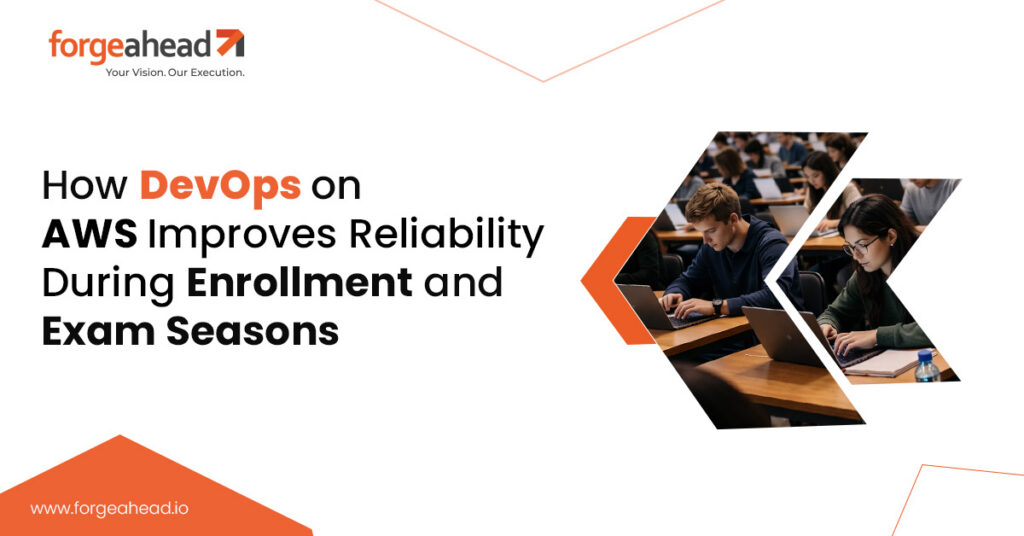
Organizations using flexible cloud infrastructure report around 30% higher organizational performance. That performance gap often shows up during moments when systems face concentrated demand and limited room for error. Enrollment windows and exam seasons create those conditions for academic platforms, with sharp traffic spikes that follow a fixed calendar. Application behavior during these windows depends on how well scaling, deployments, and recovery are engineered ahead of time.
Students and faculty expect registration and assessment systems to remain available throughout these periods, without delays or failures. Even brief disruptions can interrupt exams, block course enrollment, and weaken trust. AWS DevOps for education supports reliability during peak academic cycles through disciplined engineering practices, automation, and cloud-native operations designed for predictable surges.
Why Traditional Systems Fail During Enrollment and Exam Peaks
Peak-season failures rarely happen because of traffic alone. They usually stem from software design and operational practices. Legacy architectures often rely on static capacity planning, provisioning hardware for the worst-case scenario that sits idle most of the year yet struggles when thousands of students try to log in at the same time.
Common failure points include:
- Manual Deployments: Releasing patches during critical windows using checklists can introduce human error.
- Siloed Operations: Developers and operations working without coordination slow down incident response.
- Limited Observability: Without real-time telemetry, IT teams often discover problems only after users are affected. Industry reports show that nearly a quarter of mission-critical systems are approaching end-of-service, which makes them fragile under heavy loads.
Ensuring Reliability During Peak Seasons with DevOps on AWS
Handling enrollment and exam season surges requires platforms that scale automatically and recover from failures quickly. AWS DevOps for education leverages managed services that reduce the complexity of maintaining physical servers, therefore allowing engineers to focus on the quality of the code.
Key principles include:
- Infrastructure as Code (IaC): Every configuration and change is tracked, tested, and reversible, reducing risk when systems scale.
- Continuous Integration and Continuous Deployment (CI/CD): Updates roll out smoothly, which minimizes disruption for students and faculty.
This approach lays the foundation for cloud reliability for universities, where the systems are designed to expect issues and recover automatically.
What DevOps Practices Prevent System Downtime in Education
Maintaining near-perfect reliability during high-stakes enrollment and exam periods requires several DevOps capabilities:
- Automated, Safe Deployments: CI/CD pipelines enable progressive delivery, letting a small portion of traffic access a new version of the enrollment portal first. Blue/green and canary releases help test changes in real time, and automated rollbacks handle any unexpected issues. Feature flags allow developers to turn off resource-heavy features, such as advanced search filters, during peak exam hours without redeploying the system.
- AWS Scalability for Universities: AWS Auto Scaling adjusts the application layer dynamically based on demand. Serverless patterns with AWS Lambda handle sudden bursts, ensuring millions of students can log in at the same time without overwhelming the database.
- Observability and Fast Incident Response: Tools such as Amazon CloudWatch and AWS X-Ray provide end-to-end visibility. Proactive alerts catch performance drops before they affect students, significantly reducing the time spent handling support cases compared to traditional operations.
- Security and Governance: Policy-as-code ensures that encryption and compliance standards, such as FERPA, remain enforced even during rapid scaling. Systems stay secure and reliable when student activity is at its peak.
How AI-Assisted DevOps Ensures Reliability During Peak Academic Seasons
High-demand periods such as enrollment and exam seasons require platforms that can anticipate and correct issues without human intervention. Agentic AI, autonomous agents that act as a digital teammate within the DevOps lifecycle, is becoming central to managing these academic systems. These agents go beyond simply displaying logs. They analyze telemetry in real time, spot anomalies that traditional thresholds might miss, and perform performance optimizations automatically.
Recognizing patterns in historical enrollment and exam data allows agentic AI to anticipate failures before they occur. The system can self-correct by refactoring bottlenecks or rerouting traffic, keeping registration and assessment portals responsive even under unprecedented demand. AI-assisted DevOps ensures that student experiences remain smooth while engineers focus on improving features and code quality.
Why Reliability Is a Software Engineering Problem
Many assume that simply moving an application to the cloud guarantees reliability, but that is not the case. Transferring a poorly written, monolithic system to AWS often leads to what some call a “cloud-hosted failure.” Reliability starts with software engineering. It relies on modern application patterns, such as breaking monoliths into microservices and optimizing code for cloud-native performance. True resilience comes from combining high-quality code, a modern tech stack, and the DevOps maturity to manage it effectively. Modernized applications built on cloud-native patterns help prevent the technical debt that still slows innovation in a third of enterprises.
How Forgeahead Enables Reliable Enrollment and Exam Platforms on AWS
Modernizing the software that powers higher education requires an engineering-first approach. Forgeahead, an AWS Advanced Tier Partner, helps educational service providers modernize their legacy applications.
Forgeahead focuses on software transformation, not just infrastructure management:
- Legacy Modernization: Refactoring monolithic applications into scalable microservices to handle enrollment peaks.
- Security-First DevOps: Implementing CI/CD pipelines that integrate compliance from the first line of code.
- AI-Driven Optimization: Leveraging agentic AI to assist in code analysis, automated testing, and performance refactoring.
Forgeahead supports platforms serving millions of students, helping them deliver predictable reliability during peak seasons and preparing them to support increasing student activity and platform usage.
Conclusion
Peak-season reliability results from deliberate engineering choices. DevOps on AWS, enhanced with AI and modern software patterns, enables platforms to manage enrollment and exam season traffic smoothly. Reliability extends beyond a technical metric and forms the foundation of student trust.
Does your platform struggle during peak traffic? Contact Forgeahead today to learn how our software modernization and DevOps expertise can ensure your next enrollment season is your most reliable one yet.
FAQs
Blue/Green deployments run updates in a separate environment and switch traffic only after verification, keeping student sessions uninterrupted.
Serverless scales instantly for sudden traffic spikes, while containerized approaches work better for steady, consistent loads.
Forgeahead partners with Educational Service Providers and EdTech companies to modernize the platforms universities rely on.
Agentic AI analyzes code, generates tests, and monitors live systems to optimize performance during high-traffic periods.
Forgeahead uses modernized applications, DevOps best practices, and AI-assisted monitoring to keep platforms responsive and stable under heavy traffic.