Nearly 88.2% of physicians in the U.S. rely on electronic health record systems as part of daily care. This level of adoption has reshaped how healthcare data is captured and stored. Every visit adds clinical notes, lab results, prescriptions, and identifiers, steadily increasing data volumes.
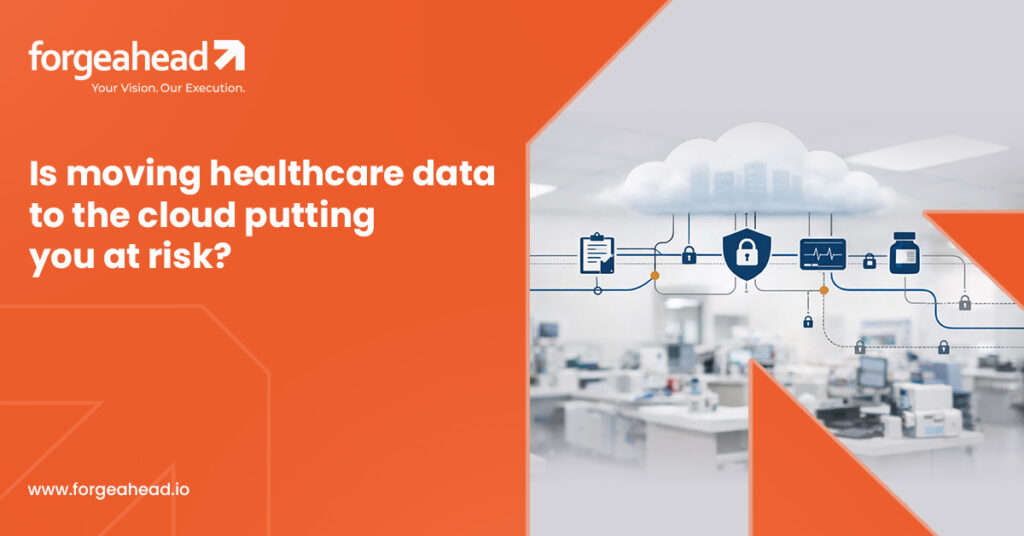
Cloud platforms offer the scale and analytics required to manage this growth, which is why organizations are moving patient data off traditional infrastructure. However, compliance officers fear the exposure of the data and related security.
Does placing patient data on cloud infrastructure actually increases the risk?
The answer depends on how the migration is handled. Cloud platforms provide mature security capabilities that many on-premises environments lack. Risk emerges when migration treats security as an afterthought rather than embedding it into architecture, access controls, and operations.
Why Healthcare Data Breaches Cost Millions
Healthcare organizations face unprecedented pressure as cyberattacks grow both in frequency and cost. The IBM Cost of a Data Breach Report 2024 shows healthcare as the most targeted and costly sector, with the average breach reaching $10.22 million. In addition to having a severe financial impact, breaches disrupt patient care and damage community trust built over decades.
Most healthcare breaches happen because of structural gaps in systems and processes.
- Cloud Misconfigurations: Security failures occur when cloud settings are too open or storage is left unencrypted. Gartner analysis through 2025 indicated that 99% of cloud security failures result from errors on the customer side rather than the provider.
- Legacy Debt: Moving decades-old monolithic applications to the cloud without re-architecting carries hidden vulnerabilities. Old weaknesses get transferred to a more exposed environment, creating ongoing risk.
- HIPAA Cloud Compliance Challenges: While the Cloud providers secure infrastructure, the organizations remain responsible for protecting the data. Understanding and managing this shared responsibility is one of the biggest hurdles in keeping patient data compliant and secure.
Why “Lift and Shift” Migrations Put Healthcare Data at Risk
Many organizations try to save time by taking an on-premises application and placing it into a cloud virtual machine. In healthcare, this shortcut can create serious security gaps.
A secure migration requires designing applications for the cloud rather than just replicating existing infrastructure. Treating the cloud as just another server ignores built-in governance, identity controls, and automation that improve security. Without a modernization strategy, old risks simply follow the application to a new environment.
Re-Architecting with a Security-First DevOps Mindset
Mitigating risk starts with following AWS best practices for secure healthcare data migration. This begins with the AWS Well-Architected Framework (WAPP), specifically the Security and Reliability pillars.
A Security-First DevOps approach embeds compliance directly into the code rather than treating it as a once-a-year task. Automated tools can detect misconfigured S3 buckets or unauthorized access in real time and resolve issues before they escalate. IBM reports that organizations using security AI and automation extensively save an average of $2.2 million per breach compared to those that do not.
Using Agentic AI to Protect Sensitive Healthcare Data
Agentic AI brings a new level of intelligence to cloud security. Unlike standard automation, AI agents can perform complex reasoning and act as smart assistants during modernization and migration.
- Analyze Legacy Code: Map data dependencies and locate PHI across millions of lines of legacy code automatically.
- Automated Refactoring: Help engineers transform legacy components into secure, isolated microservices.
- Continuous Observability: Detects compliance drift when small changes in the environment create potential security gaps.
How Forgeahead Secures Your Healthcare Transformation
Modernization is the strongest way to protect healthcare data. Forgeahead Solutions, with the support of AWS, re-engineers systems on the cloud to address healthcare’s unique challenges. Our approach is designed to solve the specific complexities of the healthcare sector through:
- AWS Well-Architected Partnership (WAPP): As an Advanced Tier Partner, we perform in-depth reviews to ensure cloud revamps meet strict standards for security, performance, and reliability.
- Agentic-Led Modernization: Agentic AI accelerates the transformation of legacy monoliths. AI agents analyze, refactor, and test code, reducing errors that often lead to misconfigurations.
- Security-First DevOps: Automated Compliance-as-Code pipelines scan every deployment against HIPAA requirements, which makes security an ongoing part of development.
- Tech Stack Migration with Predictability: Outcome-driven product pods manage software upgrades and framework transitions, therefore ensuring minimal disruption and maintaining data integrity throughout the process.
Final Takeaways
Healthcare data is valuable but comes with serious risks, and moving to the cloud adds both opportunity and exposure. Modernization, security-first DevOps, Agentic AI, and AWS best practices help turn legacy systems into secure, efficient, and compliant cloud applications. Smart software migrations and automation make risks manageable, keeping patient data safe and operations running smoothly.
Forgeahead Solutions partners with healthcare organizations to deliver these transformations confidently. Connect with our experts to learn how your organization can modernize securely.