|
Getting your Trinity Audio player ready...
|
Only 15% of IT application leaders are currently piloting or deploying fully autonomous AI agents. This signals that agentic systems are still early in enterprise adoption, even as interest in automation-led engineering continues to grow.
Legacy systems continue to stifle innovation even after successful cloud adoption. Many organizations already run their workloads on AWS, yet their underlying codebases remain anchored by design decisions from a decade ago. These older architectures, often built as rigid monoliths with tightly coupled logic, limit the speed, scalability, and integration required for modern AI systems.
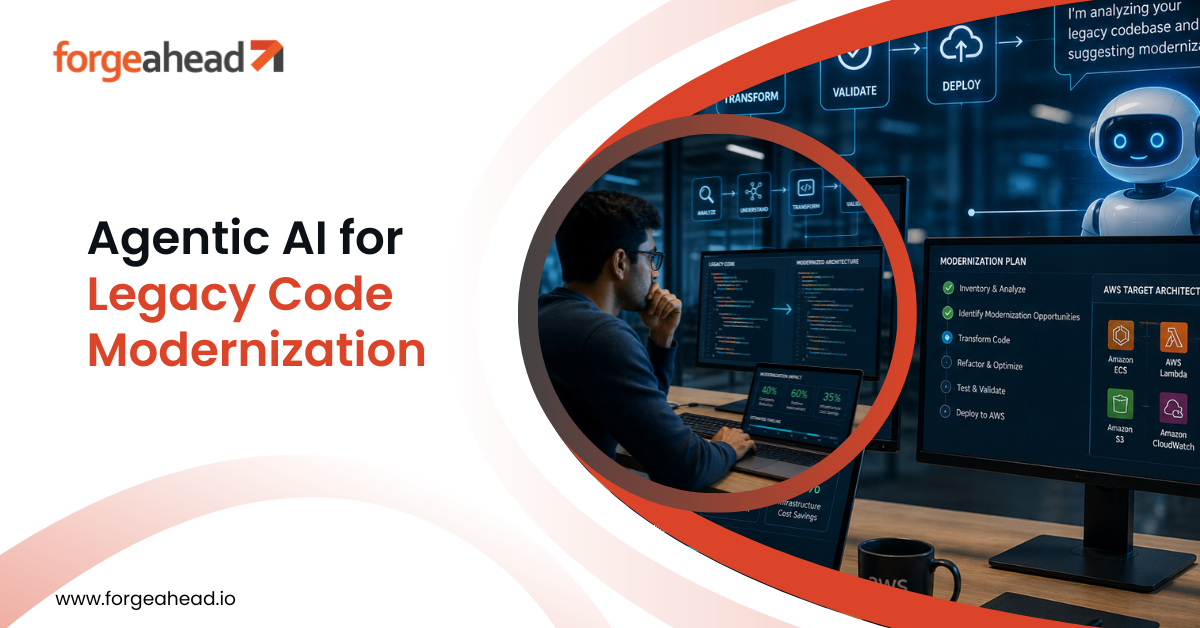
As a result, modernization efforts often slow down when manual refactoring becomes the primary approach. Agentic AI is now changing that equation by introducing autonomous assistance into engineering workflows. Agentic AI is now being applied to legacy code modernization on AWS, enabling faster analysis, refactoring, and system transformation with reduced manual effort.
Why Legacy Code Blocks AI Readiness
The divide between legacy systems and AI readiness comes from how differently they are built. AI workloads depend on modular structures, real-time data access, and API-driven flexibility, while older systems were designed around tightly coupled and static designs.
- Monolithic Architecture: Tightly coupled code limits how easily AI services can be introduced or scaled across components.
- Hard-Coded Logic: Fixed business rules reduce flexibility and make it difficult to introduce AI-driven decisioning.
- Outdated Data Access: Legacy data flows are not designed for high-speed, real-time streams needed by LLMs and predictive systems.
Traditional modernization approaches depend heavily on manual refactoring, which slows down progress when systems grow in complexity. Engineering teams now need a force multiplier to keep modernization efforts aligned with AI requirements.
How Agentic AI Changes Modernization Workflows
Agentic AI introduces a different approach to modernization by handling tasks through autonomous reasoning rather than isolated code suggestions. Unlike traditional tools that generate snippets, agentic systems analyze systems end to end and coordinate multi-step engineering actions across complex environments.
- Context-Aware Analysis: Agentic systems interpret large and often undocumented codebases to surface hidden dependencies and structural relationships that are difficult to detect manually.
- Workflow Coordination: Multiple activities such as code analysis, refactoring, and validation are connected into a continuous sequence, reducing the need for manual handoffs between steps.
- System Understanding: These systems maintain awareness of application architecture as a whole, allowing decisions that account for interdependencies rather than isolated components.
This capability changes how modernization is executed within engineering pipelines, reducing reliance on manual coordination and introducing more structured, automated execution paths.
Agentic AI vs. Traditional Modernization Approach for Enterprises
| Feature | Traditional Modernization | Agentic AI Modernization |
| Code Analysis | Manual, time-intensive documentation | Autonomous mapping of dependencies |
| Refactoring | Human-led, prone to error | Suggested modularization patterns |
| Scalability | Limited by developer bandwidth | Scalable execution of routine tasks |
| Optimization | Periodic manual review | Continuous performance monitoring |
Where Agentic AI Fits in AWS-Based Modernization
AWS provides the execution environment where modernization happens, while agentic AI adds an intelligence layer that operates across that environment. As systems evolve through services like AWS Lambda for serverless workloads, Amazon ECS for containerized applications, and Step Functions for orchestration, agentic systems help map dependencies across distributed components. AWS Transform strengthens this layer through agentic modernization capabilities.
By improving visibility into system behavior and highlighting architectural improvements, these agents support more informed decision-making during modernization. This reduces uncertainty when working across complex AWS environments and improves precision in execution.
How Agentic AI Accelerates Legacy Code Modernization
Agentic AI improves the pace of modernization by handling repetitive analysis and coordination tasks across complex legacy systems, especially when dealing with large monolithic codebases on AWS environments.
- Code Analysis and Dependency Mapping: Agents scan monolithic systems to identify tightly coupled modules that are better suited for extraction into microservices. They also surface hidden dependencies that are often missed during manual discovery, especially in older and poorly documented codebases.
- Automated Refactoring Support: Agents suggest modular breakdowns and assist in rewriting legacy components into cloud-native patterns. Repetitive refactoring work gets reduced, allowing engineering effort to focus on architectural decisions and system design.
- Testing and Validation Assistance: Modernization risks often come from breaking existing functionality. Agents generate test cases for refactored components and validate consistency between old and new behavior, helping maintain functional parity during transformation.
- Continuous Optimization: After migration to AWS, agents continue to monitor system performance. They identify bottlenecks, suggest resource adjustments, and keep applications aligned with changing workload
Risks and Governance in Agentic Modernization
While the speed gains are substantial, agentic modernization requires strict governance. Human validation remains essential, particularly for critical business logic. Organizations must implement robust access controls in code repositories and ensure that all agent-driven changes are fully traceable. By monitoring agent decisions within production pipelines, teams can ensure that speed does not come at the expense of system stability.
How Forgeahead Enables Agentic Modernization on AWS
Forgeahead acts as the execution layer that bridges the gap between legacy reality and AI-powered scalability. We bring together modernization engineering and intelligent automation to support large-scale legacy transformation.
- AWS Cloud and DevOps Engineering: We design scalable, cloud-native environments where agentic systems can operate effectively and securely.
- Legacy Application Modernization: We specialize in breaking down complex monoliths into modular services, preparing them for AI-assisted refactoring.
- Agentic AI Enablement: We build internal platforms where AI agents support your engineering team in code analysis, testing, and continuous migration support.
- GenAI Integration: We ensure your modernized workflows are fully aligned with enterprise-grade AWS AI systems, creating a platform that is ready for both today’s migrations and tomorrow’s GenAI applications.
We view legacy transformation as an orchestrated, intelligent process rather than a manual engineering effort.
Modernize legacy systems using Agentic AI. Partner with Forgeahead to accelerate AWS transformation.
Frequently Asked Questions
1. Is agentic AI going to replace my software engineers?
No. Agentic AI works as a force multiplier that automates repetitive tasks like refactoring and testing so engineers can focus on architecture and design decisions.
2. What is the biggest risk when using agents for code refactoring?
The main risk is logic hallucination, which is why human review remains essential for validating all agent-generated changes.
3. Does my system need to be partially modernized already to use agents?
No. Agents can work within legacy systems and also help define clearer architectural boundaries during modernization.
4. How does this differ from traditional GenAI coding tools?
Agentic systems handle full workflows, including analysis, refactoring, code generation, and test creation, instead of responding to isolated prompts.
5. Are agentic modernization workflows secure?
Yes. When deployed within AWS using VPC isolation and strict IAM controls, code and data remain within a secure enterprise boundary.