|
Getting your Trinity Audio player ready...
|
57% of higher education institutions already have an AI policy in place, showing how quickly AI has entered formal education planning and governance. That institutional push is now reflecting in digital learning platforms as well. EdTech platforms are seeing rapid AI adoption across learning systems, from personalized tutoring to automated content creation and assessments. Still, there is a gap between experimentation and production-scale deployment.
While roughly 86% of students globally already use AI tools in their studies, many platforms struggle to move AI initiatives beyond pilots. The gap is not about access to models. It comes down to infrastructure readiness, data maturity, and operational discipline.
AI readiness for EdTech platforms on AWS becomes central here. Most systems are not built for real-time inference, continuous training, or large-scale personalization, and data often remains scattered across systems without consistent structure.
AI Readiness in EdTech Platforms on AWS Explained
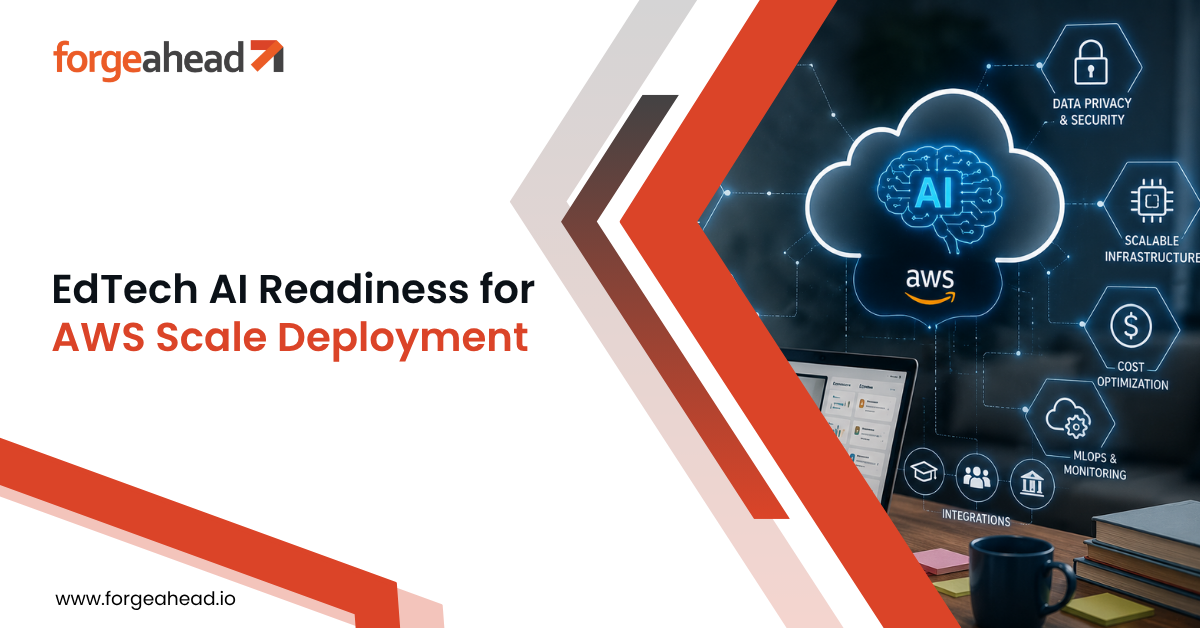
AI readiness is not about adding an LLM API to an existing front end. It reflects how well a platform can support data flow, scale, latency, and governance needs of AI-driven learning systems. For EdTech platforms on AWS, this readiness comes down to a few core pillars.
- Data readiness: Data needs to stay unified, clean, and available in near real time so learning signals can support personalization and recommendations.
- Architecture readiness: Systems need to handle variable workloads from AI inference and training without breaking consistency in performance.
- Security and compliance readiness: Student data protection requirements such as FERPA, COPPA, and GDPR need to stay aligned with how AI services process and store information.
- Operational readiness: Monitoring for model drift, accuracy, and latency becomes part of day-to-day system behavior rather than an occasional check.
Why Most EdTech Platforms Struggle with AI at Scale
AI pilots in EdTech often perform well in controlled environments, but production rollouts reveal underlying gaps in system design and data flow. These limitations become especially clear when AWS EdTech platform scalability is tested under real-world workloads.
- Fragmented Data Silos: Learning data is often trapped across disparate systems, such as LMS, video servers, assessment engines, and user-interaction logs. Without a unified data foundation, AI cannot build a holistic view of the learner.
- Legacy Monoliths: Many EdTech platforms are built on monolithic architectures that cannot support the high-frequency, real-time inference calls that modern AI demands.
- Observability Gaps: Unlike traditional software, AI behavior is probabilistic. Without strong telemetry, tracking model drift, output quality, and response accuracy becomes difficult, especially when content generation is involved.
- Inconsistent Data Pipelines: Personalized learning recommendations often fail at scale simply because the data flowing into the model is inconsistent or suffers from high latency, rendering the “personalization” irrelevant.
What Scalable AI Architecture Looks Like on AWS
Scaling generative AI in education technology requires a shift away from static, batch-oriented designs toward a dynamic, cloud-native ecosystem.
| Feature | Traditional EdTech Setup | AI-Ready AWS Setup |
| Data Processing | Batch-oriented data silos | Real-time streaming pipelines (Kinesis) |
| Content Delivery | Static, pre-packaged lessons | Personalized, dynamic content generation |
| Updates | Manual model retraining | Automated retraining & MLOps |
| Scalability | Limited by fixed infrastructure | Elastic scaling via AWS managed services |
An AI-ready architecture on AWS typically leverages an event-driven design, utilizing Amazon S3 as a data lake foundation, Amazon SageMaker for model hosting, and feature stores to ensure that model inputs remain consistent across different learning contexts.
The Role of Generative AI in Modern EdTech
Generative AI is changing how EdTech platforms create assessments, deliver tutoring support, and generate adaptive explanations for learners. This directly impacts how AI is deployed within e-learning infrastructure and how those systems are architected and governed at scale. It enables faster content creation and more personalized learning experiences. At the same time, it introduces concerns around accuracy in generated content and rising inference costs at scale. As a result, outcomes depend less on the model itself and more on how the surrounding system is designed.
Reliable use of generative AI requires validation layers for output checks, guardrails to control responses, and human-in-the-loop workflows for sensitive learning scenarios. These controls help ensure that AI-generated content remains aligned with learning objectives.
How to Deploy AI at Scale on AWS for EdTech Platforms
To move from pilot to production, EdTech leaders must prioritize system design discipline:
- Unify Data: Establish a robust data layer that aggregates learning signals across all interactions.
- Modularize AI Logic: Instead of embedding AI logic into a monolith, build modular AI services that can be updated independently.
- Implement MLOps: Use CI/CD for machine learning to ensure that models can be continuously tested, deployed, and monitored.
- Build Observability: Implement comprehensive tracking for accuracy, latency, and infrastructure costs.
- Enforce Guardrails: Build automated validation gates that catch and correct AI hallucinations before they reach the learner.
Forgeahead’s Approach to Scaling AI in EdTech
Forgeahead helps EdTech platforms build the engineering foundation required for production scale AI. The focus stays on strengthening systems so AI runs reliably at scale.
- Application modernization: We break monolithic EdTech systems into modular architectures that support AI integration and continuous feature evolution.
- AWS native data pipelines: We build strong data foundations that support real time inference, personalization, and consistent learning experiences across users.
- Agentic AI enablement: We design agent based systems that handle tasks such as automated test creation and administrative analytics, which reduces operational load and improves system efficiency.
AI success in education depends on engineering maturity. A strong foundation allows platforms to support growing learner demand and evolving AI capabilities on AWS.
Ready to build a production-grade AI foundation for your EdTech platform? Partner with Forgeahead to modernize your architecture and scale your AI capabilities on AWS.
Frequently Asked Questions
1. Is it possible to use off-the-shelf AI tools for production EdTech?
They work for early prototypes, but production systems need deeper integration for privacy, cost control, and scalability.
2. How do I balance AI-driven personalization with data privacy?
Use privacy by design with isolated environments, controlled access, and anonymization before any model interaction.
3. What is the most common reason AI features fail in EdTech?
AI tools fail when they sit outside the learning flow and users have to switch context to access them.
4. How does Forgeahead handle hallucination in educational content?
We use Retrieval Augmented Generation and validation layers grounded in verified curriculum data.
5. How do I justify the cost of AI infrastructure to my board?
Focus on reduced manual effort, faster content delivery, and lower cost per learner at scale.