|
Getting your Trinity Audio player ready...
|
Around 86% of enterprises expect their AI infrastructure budgets to increase over the next three years. Yet, larger investments do not automatically create systems that are ready for AI.
Many organizations already run critical workloads on AWS, but their applications still operate with legacy architectural patterns. Cloud adoption has changed the infrastructure, while application design, data access, and integration models often remain the same.
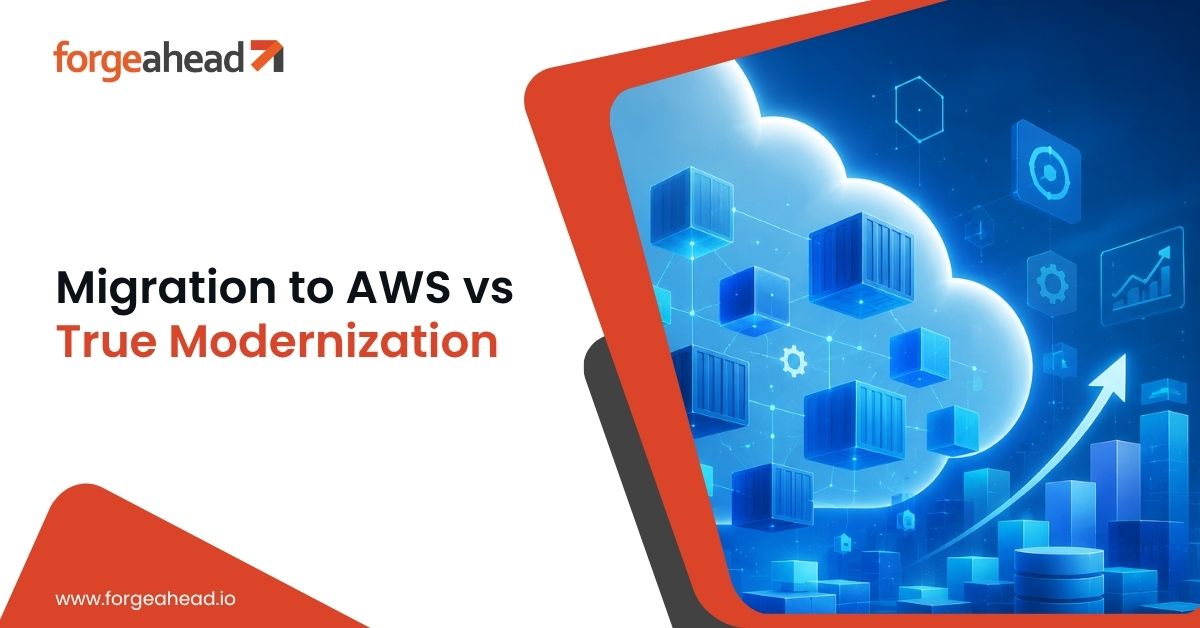
This is where AWS migration vs modernization becomes an important distinction. AWS migration changes where applications run. Modernization changes how they are built and how they support AI-driven workloads. As AI adoption grows, modular architectures, accessible data, and connected systems play a larger role in determining what AI can actually achieve.
Organizations that stop at migration often find that cloud-hosted legacy applications carry the same limitations into AWS. Modernization determines whether those systems can support AI at scale.
What Is the Difference Between AWS Migration and Modernization?
To understand the difference, it helps to separate workload migration from application modernization.
| Feature | AWS Migration (Lift and Shift) | Cloud Modernization |
| Primary Goal | Data center exit, cost reduction | Agility, AI-readiness, innovation |
| Architecture | Replicates existing on-prem design | Shifts to cloud-native, microservices |
| Data Access | Often relies on monolithic DBs | Enables real-time, event-driven access |
| Outcome | Infrastructure on the cloud | A flexible, responsive ecosystem |
Migration, often called lift and shift, moves existing applications to AWS with minimal changes to their structure. While this improves scalability and infrastructure flexibility, the underlying application design stays the same. Refactoring takes a different approach, where applications are redesigned to use cloud-native capabilities such as microservices, serverless computing, and event-driven APIs that support AI workloads more effectively.
Lift and shift keeps existing system behavior intact, while refactoring reshapes how applications are built to support modern workloads like AI.
Why Cloud-Migrated Applications Face AI Challenges
AI depends on data that is accessible, structured, and available when needed. Applications that have only gone through a lift-and-shift migration often face limitations that make AI adoption difficult.
- Monolithic Limits: Tightly coupled architectures make application changes complex and time-consuming. Integrating AI capabilities into these environments often requires significant rework across interconnected components.
- Inconsistent Data Pipelines: AI applications rely on timely access to data and context. Legacy databases and isolated data stores can restrict information flow, making it difficult for AI models and agents to access the data they need.
- Limited Observability: AI behavior is probabilistic. In a migrated legacy system, it is difficult to monitor exactly how an AI model arrives at a conclusion because the system-level visibility is poor.
- Retrofitting Governance: When you move an old system, you move the old security flaws with it. Retrofitting AI governance onto a legacy foundation is often ineffective compared to building “governance by design” into a modernized architecture.
Why Modernization Becomes Essential for AI Adoption
AI performance is a direct reflection of the structure of the system it operates within. Modernization shapes how services exchange data and interact with one another, which directly influences AI performance. Modular, API-driven applications give AI systems timely access to the data and functionality they need, while tightly coupled architectures can limit responsiveness and consistency.
Consistent data flows, low-latency API access, and well-defined service interactions create the conditions that support reliable AI adoption. Cloud modernization for AI readiness supports these conditions by aligning application architecture with how AI systems consume data and interact with services.
What Modernization Looks Like in AWS Environments
Modernization on AWS involves deliberate architectural changes that improve how applications operate, communicate, and support emerging technologies such as AI. In practice, this includes:
- Decomposing Monoliths: Large applications are broken into smaller, modular services using AWS technologies such as ECS and Lambda, making updates and integrations easier to manage.
- Event-Driven Communication: APIs and services exchange information through events, which supports faster data movement and real-time interactions required by AI applications.
- Building Data-Aware Pipelines: Data pipelines prepare, enrich, and deliver information in formats that AI models and agents can readily use.
- Observability by Design: Services such as AWS CloudWatch and AWS X-Ray provide visibility into application behavior and AI interactions, helping engineering teams monitor performance and usage patterns.
Why AI Adoption Depends on Modernization
AI adoption is less about the infrastructure location and more about system readiness. AI agents require structured, predictable access to system services to perform tasks. Without modernization, an AI agent trying to interact with your system will be like a modern high-speed vehicle trying to drive on a crumbling, one-lane dirt road. When you modernize, you are essentially building the “digital highway” that allows AI to move at the speed of your business.
How Forgeahead Helps Bridge AWS Migration and Modernization
Forgeahead focuses on application modernization for AI enablement across AWS environments, helping systems support AI workloads with better structure, integration, and operational clarity.
- Cloud and DevOps Engineering: AWS architectures are designed with reliability, observability, and security in mind, creating a strong foundation for AI workloads and business-critical applications.
- Modernization-First Engineering: Complex monolithic applications are restructured into modular services that support easier integration, faster development cycles, and AI-driven capabilities.
- GenAI Readiness: We structure your systems to ensure that data flows securely and efficiently, making your platform an ideal host for LLMs and enterprise AI workflows.
- Agentic AI Enablement: We build AI agents that assist in the modernization process itself, automating refactoring, testing, and system optimization, so your systems improve faster than manual engineering would allow.
We focus on the underlying structure that enables AI to operate effectively. While others focus on the infrastructure, Forgeahead focuses on the architecture that makes that infrastructure actually work for you.
AWS migration was just the start. Modernize your AWS environment to make AI work at scale. Contact Forgeahead to discuss your modernization roadmap today.
Frequently Asked Questions
- Is it possible to run AI on an un-modernized system?
Technically yes, but it often leads to high latency, inconsistent outputs, and security risks that limit real production use. - Does modernization always require a total rebuild?
No. A phased approach works well, where critical AI-ready modules are refactored first to deliver value without replacing the entire system. - Why is cloud-native design better for AI than lift-and-shift?
Cloud-native systems are modular and elastic, which helps AI workloads scale up during demand spikes and scale down when usage drops. - How does modernization improve AI governance?
Modernized architectures enable fine-grained access controls, allowing precise restriction of what data AI systems can access. - What is the first step in starting an AI-enablement modernization?
It begins with mapping system dependencies to identify high-impact areas for refactoring and aligning them with AI integration needs.