|
Getting your Trinity Audio player ready...
|
Over 40% of agentic AI projects will be canceled by the end of 2027 due to escalating costs, unclear business value, or inadequate risk controls, according to Gartner, Inc. This highlights a growing enterprise reality, one where AI initiatives are increasingly failing not because of model limitations, but because of foundational readiness gaps in the underlying architecture.
In the race to adopt generative AI, many enterprises are encountering an unexpected barrier between experimentation and scale. While proof-of-concepts often demonstrate strong potential, many initiatives struggle when moving into production environments where complexity, governance, and performance demands increase significantly.
Running workloads on AWS provides the raw power for innovation, but simply being on the cloud is not enough. Without an AWS Well-Architected review for AI readiness, hidden design flaws in architecture, data flow, and observability can block scale and undermine AI investments long before they deliver value.
This is where an AWS Well-Architected review AI blockers enterprise checklist becomes critical, helping teams systematically surface architectural, data, and observability gaps that typically remain invisible during standard cloud assessments.
Why Cloud Adoption Doesn’t Guarantee AI Readiness
There is a significant functional divide between simply “running on AWS” and having an architecture that is truly “AI-ready.” Many organizations have successfully migrated legacy monoliths to the cloud, but these systems often retain design patterns that were never intended for the fluid, high-velocity demands of modern AI workloads.
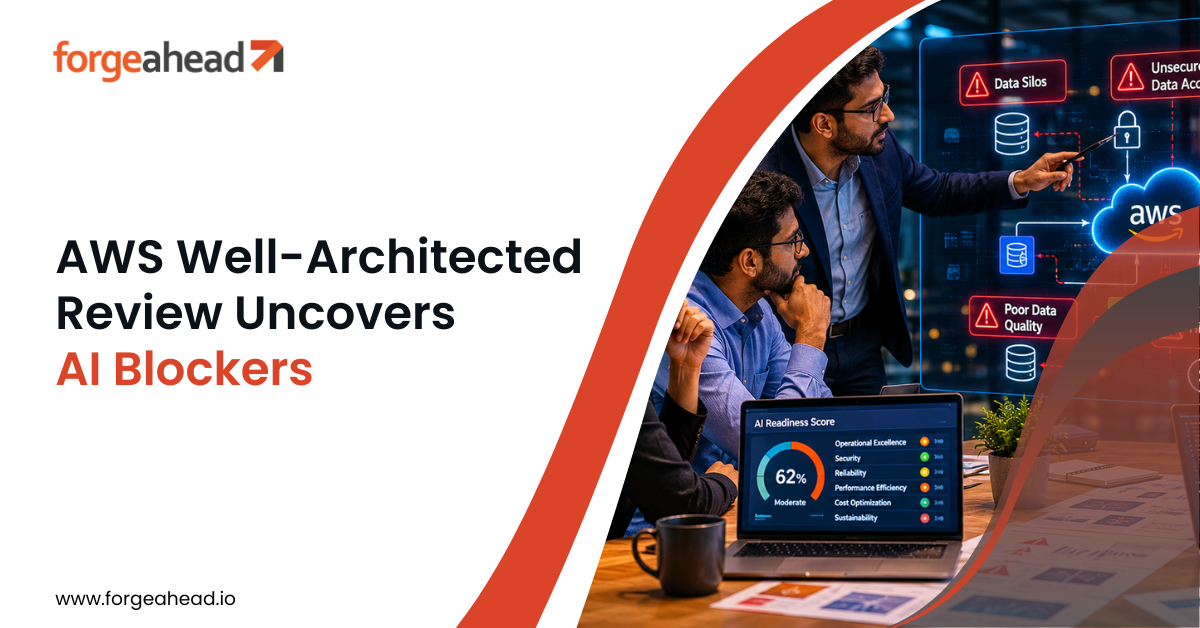
As a result, several hidden blockers begin to surface. Rigid, tightly coupled architectures make it difficult to integrate foundation models or introduce modular AI services. Inconsistent data pipelines introduce noise and “dirty” inputs that reduce model reliability. At the same time, limited observability prevents teams from tracking model behavior, detecting drift, or understanding system-level performance in real time.
If your infrastructure was originally built for static reporting rather than event-driven intelligence, you are likely operating with structural constraints that silently limit AI performance, security, and scalability.
What a Well-Architected AWS Review Actually Covers
The AWS Well-Architected Framework serves as the standard for evaluating cloud architecture quality, built around six pillars: Operational Excellence, Security, Reliability, Performance Efficiency, Cost Optimization, and Sustainability. When applied through an AI-focused lens, this review becomes less of a general health check and more of a targeted assessment of AI readiness across the stack.
An AWS WAFR GenAI workload assessment extends this approach by specifically evaluating how well architectures support generative AI and agentic workloads at scale.
- Operational Excellence: It evaluates whether AI workflows are automated and repeatable, or still dependent on manual intervention.
- Security: It examines whether data access, governance, and model usage comply with strict LLM and enterprise AI security requirements.
- Reliability: It assesses how well data pipelines and services handle spikes in demand, including surges driven by AI workloads.
- Performance Efficiency: It determines whether compute and storage layers are optimized to support the high throughput required for generative AI systems.
- Cost Optimization: It identifies inefficiencies such as unnecessary model calls or poor routing strategies that increase AI operating costs.
By uncovering issues such as data silos, weak API integrations, and limited telemetry, the review helps prevent architectural bottlenecks that would otherwise require expensive and time-consuming rework once systems are already in production. These findings surface critical cloud architecture AI readiness gaps that often remain invisible in traditional cloud assessments.
Hidden Infrastructure Blockers That Impact AI Performance
Even mature engineering teams tend to overlook infrastructure constraints that only surface when systems are evaluated through an AI-first lens.
- Data Pipeline Latency: AI systems depend on fresh, contextual data. Batch-oriented pipelines introduce delays that can render model outputs outdated by the time they are consumed.
- Infrastructure Scaling Limits: Improper autoscaling configurations or insufficient compute capacity for model inference can quickly lead to throttling, degraded performance, and failure under peak AI workloads.
- Governance and Auditability: Many implementations lack proper lineage tracking, making it difficult to explain or trace why a model produced a specific output, creating both compliance and operational risks.
- Observability Gaps: Traditional monitoring focuses on infrastructure health rather than AI behavior. Without telemetry for model performance, data quality, and drift, teams have limited visibility into when or why AI systems begin to degrade.
How to Use the AWS Well-Architected Framework to Prepare for GenAI
Conducting an effective review requires more than just checking boxes; it demands a structured, proactive methodology. An AWS generative AI–focused review ensures that each stage is evaluated specifically through the lens of AI workload readiness:
- Discovery & Mapping: Identify existing workloads and map them against their specific AI requirements across the system.
- Architecture Analysis: Use tools like Amazon CloudWatch and AWS X-Ray to visualize how data moves from source systems to AI models.
- Gap Identification: Evaluate the architecture against AWS best practices for generative AI, focusing on patterns that restrict AI readiness, such as monolithic data access or the absence of API-first design.
- Prioritization: Rank identified improvements based on their impact on AI performance, scalability, and reliability.
- Recommendations: Apply AI-aware modernization steps, including refactoring legacy components into modular services and optimizing storage policies such as S3 lifecycle configurations for training and inference datasets.
Forgeahead’s Role in AI-Ready AWS Modernization
A review is only the starting point. Forgeahead acts as the engineering partner that operationalizes these insights, translating architectural findings into a concrete modernization roadmap. We help enterprises move beyond the prototype-to-production gap by focusing on three critical areas:
- Cloud & DevOps Engineering: We design observable, resilient AWS environments that allow AI workloads to scale without infrastructure bottlenecks.
- Data & AI Pipeline Modernization: We optimize data flows for RAG, LLM, and agentic workloads, ensuring AI systems receive fast, reliable, and high-quality context.
- GenAI & Agentic Enablement: We implement intelligent AI agents that continuously monitor, maintain, and optimize systems, reducing operational overhead and enabling teams to focus on innovation.
We translate architectural insights into execution, ensuring your infrastructure accelerates your AI strategy rather than constraining it.
Conclusion
AI blockers in AWS environments often hide in plain sight, masked by successful POCs that fail to scale. A Well-Architected Review, paired with expert engineering execution, is the most effective way to ensure your foundation is solid. Don’t wait for production scale to discover that your architecture isn’t ready.
Unlock the full value of your AI investments. Partner with Forgeahead to audit, optimize, and modernize your AWS environment today.
Frequently Asked Questions
1. Is a Well-Architected Review just for cost cutting?
No. It focuses on building resilient, secure, and high-performing architectures, with cost optimization being only one of its six pillars.
2. How do I know if my data is “AI-ready”?
If your pipelines have latency issues, inconsistent schemas, or lack automated validation, your data is not AI-ready.
3. Does every AI project need an “AI-lens” review?
Yes. AI workloads require an architectural shift, and an AI-focused review ensures the infrastructure supports those needs effectively.
4. What is the biggest infrastructure mistake in generative AI?
Over-reliance on a single AI provider without fallback mechanisms, which creates downtime risks during service disruptions.
5. Can Forgeahead help if we haven’t finished our first review?
Yes. Forgeahead can support early-stage discovery and assessment to establish a clear baseline and