|
Getting your Trinity Audio player ready...
|
Only about 10% of cloud transformations fully achieve expected value due to limitations in operating models, reliability practices, and engineering consistency.
That shortfall often becomes visible during everyday engineering work. Many engineering teams operate with a false sense of stability. Applications appear steady during routine operation, yet scaling events, dependency failures, or rapid deployment cycles often expose weak points that were not visible earlier. These weak points rarely come from a single faulty line of code. They usually come from misalignment across architecture, delivery practices, tooling, and operational execution. In simple terms, differences in DevOps practices across systems and services within the same organization often surface during AWS Well-Architected Reviews.
Identifying Architectural and Operational Weaknesses with AWS Well-Architected Reviews
Modernization initiatives help accelerate software delivery. However, new applications, evolving architectures, and independent engineering practices can gradually increase operational complexity.
- Custom CI/CD pipelines: Different applications often rely on separate pipelines, resulting in inconsistent security checks and release processes.
- Varying deployment practices: Release workflows can differ between groups, making deployments harder to govern and troubleshoot.
- Disconnected observability tools: Separate monitoring and observability platforms make it difficult to maintain a unified view of application and infrastructure health.
- Inconsistent security controls: Security policies and automation may vary between environments, creating inconsistencies in governance and compliance.
- Mixed technology environments: Legacy applications and cloud-native platforms often operate with different architectures, integrations, and operational models.
As a result, many of these issues remain unnoticed during routine operations. However, deployment failures, traffic spikes, service dependencies, or incident response activities often expose them. What starts as a small operational issue can quickly affect application availability, performance, or recovery times.
Architectural decisions, operational practices, and governance processes all contribute to this complexity. Without regular assessment, disconnected practices accumulate and increase production risk over time.
What Does an AWS Well-Architected Review Reveal Apart from Compliance Checks?
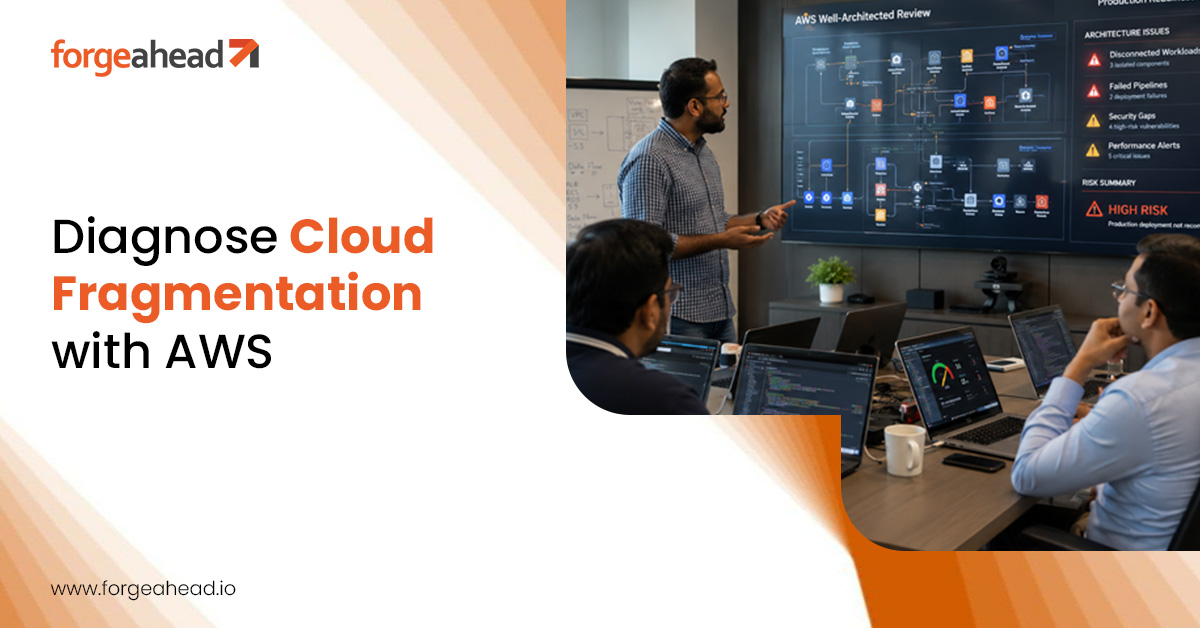
An AWS Well-Architected Review works as a cloud architecture fragmentation diagnostic tool that evaluates how systems operate in practice, not only how they are documented. It brings structure to areas that often evolve independently and helps surface issues that standard automated checks do not capture.
- Operational processes
Evaluates how deployment routines, incident handling, and system monitoring practices align with day-to-day execution. - Reliability practices
Reviews how architectures anticipate failure scenarios and maintain recovery paths during disruptions. - Security controls
Assesses how access policies, data protection, and enforcement mechanisms stay consistent across environments. - Performance efficiency and cost optimization
Examines how resource usage, scaling decisions, and cost allocation are managed across workloads.
Conversations with technical stakeholders, along with a review of existing implementation patterns, help uncover dependencies that remain hidden in automated outputs. These patterns often develop gradually as systems evolve in different directions.
Each design decision gets evaluated against AWS Well-Architected Review guidelines, which helps clarify why certain approaches exist and where inconsistencies may affect stability or delivery.
What Patterns Emerge During an AWS Well-Architected Review?
The table below outlines patterns that often point to weaknesses across architecture, operations, and delivery practices, along with how they show up in production environments:
| Area | Typical Fragmentation Signal | Potential Production Impact |
| Deployments | Different release processes across teams | Failed releases and long rollback delays |
| Monitoring | Multiple observability tools, no shared visibility | Slower incident response times |
| Security | Inconsistent governance policies | Compliance failures and security risks |
| IaC | Multiple standards/repositories for infrastructure | Operational inconsistency and drift |
| Reliability | Undefined ownership and escalation paths | Extended downtime during outages |
| Documentation | Tribal knowledge instead of documented processes | Increased human-error risk |
What the AWS WAFR Operational Excellence Pillar Reveals
The AWS WAFR operational excellence pillar helps surface how operational practices have evolved over time. It evaluates how workloads are run and how processes improve as systems change.
During a review, inconsistencies often appear in areas where operational practices have developed in different ways across environments. These differences show up even when engineering practices are strong, mainly due to variations in execution patterns and ownership.
In many cases, the assessment also shows how consistently operations are treated as code versus handled through manual steps that limit scalability. It highlights issues in incident management loops where response patterns and learning cycles are not clearly defined.
Governance practices also come into focus, especially where standards are applied unevenly. As a result, the findings point toward opportunities for more consistent automation and better-aligned operational practices across systems.
How to Use AWS Well-Architected Review to Find DevOps Fragmentation Before Production Failures
To transform the WAFR into a proactive diagnostic tool, follow this structured framework:
- Map deployment workflows: Visualize how code moves from commit to production for every team. Identify where handoffs are manual or rely on different toolchains.
- Review ownership paths: Clearly define who owns the infrastructure and the incident response for each critical workload.
- Evaluate observability: Check if disparate teams have a “single pane of glass” or if they are siloed in different logging and monitoring systems.
- Assess automation coverage: Identify tasks that are still performed manually and prioritize them for Infrastructure as Code (IaC) migration.
- Inventory tooling: Create a list of all DevOps tools in use and flag redundancies or conflicting configurations.
- Prioritize remediation: Rank findings based on the potential business risk to production, not just technical ease of implementation.
How Does WAFR Guide Continuous Modernization Efforts?
Identifying issues marks only the starting point. Insights from an AWS Well-Architected Review often feed directly into a modernization roadmap that guides how systems evolve.
Many organizations use these findings to improve platform engineering practices and strengthen DevOps automation across workloads. Alongside this, AI-assisted analysis helps review system behavior and support faster decision-making during remediation planning.
Over time, these changes improve consistency in execution, increase automation coverage, and support better recovery during unexpected events.
How Forgeahead Supports AWS Well-Architected Reviews for Modernization
Forgeahead supports organizations in applying AWS Well-Architected Review findings to real system improvements. As an AWS Well-Architected Partner, the work focuses on strengthening architecture, operations, and delivery practices across workloads.
- Structuring the Foundation: Assessing your architecture and identifying fragmentation points.
- Modernization Initiatives: Re-architecting legacy stacks and streamlining CI/CD pipelines.
- Security-First Automation: Implementing robust governance that scales with your deployment velocity.
- Agentic AI-Assisted Analysis: Leveraging modern tools to optimize your infrastructure and provide actionable modernization paths.
The engagement extends into execution support, where priorities from the review translate into planned and measurable engineering work that improves reliability and delivery performance.
Stop fixing production incidents. Start preventing them. Reach out to Forgeahead to plan an AWS Well-Architected Review and strengthen your DevOps setup through structured modernization.
Frequently Asked Questions
1. Is an AWS Well-Architected Review only for legacy systems?
No. It applies to new and existing workloads to align architecture with best practices early.
2. How often should we conduct a WAFR?
Every 3 to 6 months or after major architectural changes or new workload launches.
3. Does the review require a long production outage?
No. It is an assessment based on discussions, documentation, and configuration checks.
4. What if our teams use different languages and tools?
Differences are expected, and the review helps identify where they support flexibility and where they impact reliability.
5. How do we ensure the review leads to actual change?
Improvements can be tracked using the AWS Well-Architected Tool, with priorities set for quick wins and longer-term actions.