|
Getting your Trinity Audio player ready...
|
Modern engineering environments rely on tools spread across CI/CD, observability, security, and infrastructure management. These tools often accumulate independently across product groups, leading to overlapping capabilities and inconsistent workflows. Operational effort rises, delivery patterns vary, and visibility across the pipeline weakens. A structured roadmap for enterprise DevOps tool consolidation plays a key role in bringing structure and reliability back while keeping space for engineering flexibility. The goal stays centered on a governed platform that supports scale and predictable execution.
Why Toolchains Become Uncontrolled Over Time
Tool sprawl builds up gradually rather than appearing suddenly. Independent tool choices across delivery groups often shape it, where each group focuses on quick fixes instead of broader alignment. Short-term delivery speed often leads to adding new tools while older systems continue running alongside cloud-native stacks.
Local optimization can improve outcomes for a single group, yet it rarely aligns with broader enterprise goals. This creates situations where DevOps toolchain governance for AWS integration becomes harder to manage because tools evolve in isolation. When monitoring, logging, and security tools are selected without a shared approach, overlapping capabilities appear, integration effort increases, maintenance effort rises, and visibility across the delivery lifecycle becomes limited.
How Ad-Hoc Toolchains Affect Delivery Outcomes
The operational impact of ad-hoc toolchains shows up clearly in delivery outcomes. Siloed toolsets across groups lead to inconsistent pipelines, slower onboarding for new engineers, and security gaps caused by uneven policy enforcement.
An ad-hoc DevOps to platform engineering migration often slows down under this fragmentation. Without a unified view across tools and workflows, more effort goes into coordinating systems and reconciling data than into shipping features.
| Feature | Ad-Hoc Toolchain | Governed Platform |
| Tool Adoption | Independent and fragmented | Standardized selection |
| Integrations | Manual and brittle | Unified, automated pipelines |
| Visibility | Fragmented and incomplete | Centralized observability |
| Execution | Variable and risky | Consistent and predictable |
What a Governed DevOps Platform Looks Like
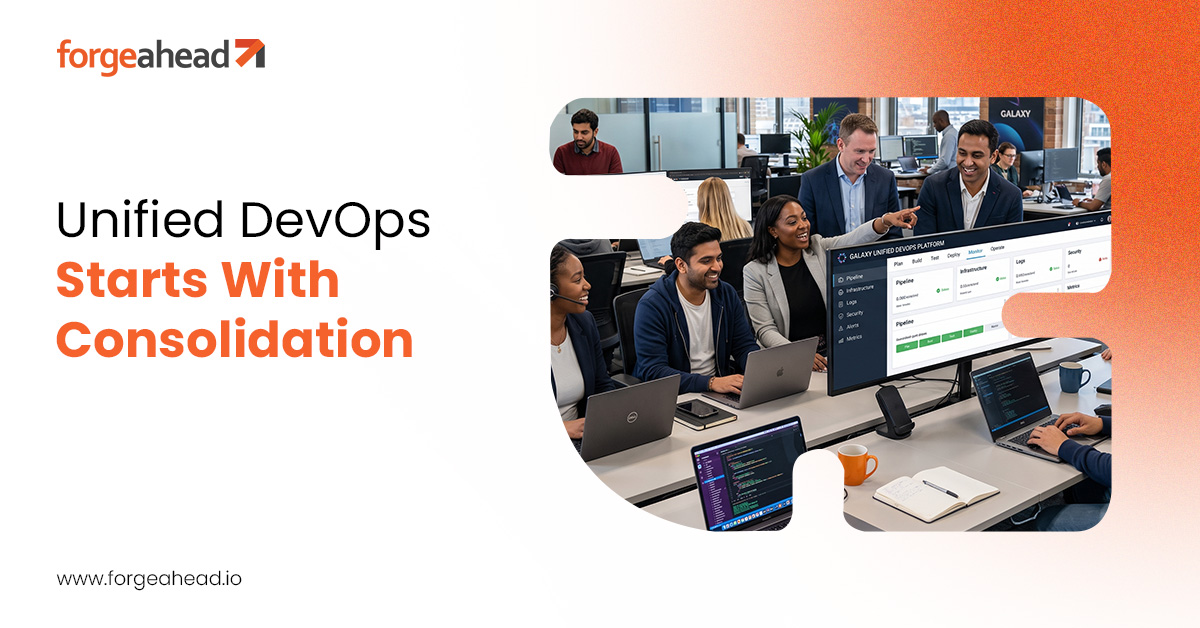
A governed approach moves attention away from managing individual tools toward improving platform-level productivity. A governed DevOps platform toolchain brings structure across delivery workflows through standardized toolsets for CI/CD, security, and observability. A clear “Golden Path” for developers embeds security and compliance into pipelines through policy-driven governance. Self-service access to these approved workflows supports consistent delivery and faster execution while keeping room for engineering autonomy in building and evolving products.
What Does an Enterprise DevOps Tool Consolidation Roadmap Look Like?
Enterprises often follow a structured roadmap to align tools and delivery workflows to reduce sprawl and increase impact:
- Phase 1: Tool Discovery and Inventory: Map every tool across all delivery groups to identify redundancies.
- Phase 2: Capability Mapping: Group existing tools into core functions: CI/CD, observability, security, and infrastructure management.
- Phase 3: Standardization Planning: Select preferred tools based on integration capability, scalability, and cloud alignment.
- Phase 4: Platform Design and Integration: Build a unified platform layer that abstracts individual tool complexity.
- Phase 5: Migration and Rationalization: Gradually sunset redundant tools while ensuring delivery continuity.
Executing a DevOps tool consolidation roadmap enterprise-wide requires tight coordination across engineering, operations, and security to ensure that standardization enhances, rather than hinders, productivity.
How AWS and Platform Engineering Support Tool Standardization
Platform engineering supports consolidation by offering reusable services and standardized pipelines that reduce variation across delivery workflows. AWS enables DevOps toolchain governance patterns through scalable CI/CD infrastructure, built-in security automation, and integrated observability capabilities. Modern platforms also apply AI-assisted automation to study tool usage patterns and guide migration planning, so consolidation decisions rely on usage data and system insights rather than assumptions.
How Forgeahead Enables DevOps Tool Consolidation
Forgeahead acts as an execution-focused engineering partner, helping you move from a fragmented state to a high-performance, governed engineering environment:
- Standardization Expertise: We help you refine your toolchains, focusing on AWS-native practices that ensure scalability and efficiency.
- Unified Developer Platforms: We design and implement IDPs that provide a cohesive developer experience, abstracting away tool complexity.
- Security-First Automation: We embed compliance and security directly into your CI/CD pipelines.
- Agentic AI Support: Our team uses AI to analyze your existing workflows, identify optimization opportunities, and modernize legacy processes.
By aligning your infrastructure with a structured, platform-led engineering model, we help you reduce tool sprawl and regain control over your delivery predictability.
Ready to streamline your engineering operations? Partner with Forgeahead to build a governed, scalable DevOps platform today.
Frequently Asked Questions
1. Is tool consolidation just about cutting costs?
Cost reduction appears as a benefit, while the main focus stays on improving operational efficiency. Consolidation reduces context switching for engineers and removes integration overhead across tools.
2. How do I prevent platform teams from becoming a new bottleneck?
Self-service access through reusable templates helps developers manage environments and pipelines without waiting on central intervention.
3. What is the biggest challenge in tool consolidation?
Cultural resistance often slows progress, especially when teams are attached to familiar tools and workflows.
4. How does AI help in this roadmap?
AI supports audit of tool usage, identifies redundancy, recommends migration paths, and generates configuration for standardized platforms.
5. How long does a typical consolidation effort take?
Most enterprise programs take 6 to 18 months and progress in phases, starting with one domain like CI/CD before expanding further.