Only about one-third of organizations have started scaling AI across the enterprise. Most AI use today remains limited to specific parts of the business. Wider use across the organization depends a lot on how data is structured and how easily it can be accessed.
For many established enterprises, innovation often meets a familiar constraint. Rigid, siloed data architecture has built up over time through layered systems, which makes access to information slow and uneven. Insights take longer to surface, and efforts to scale new initiatives lose pace along the way. Traditional data warehouses no longer match how decisions need to happen today.
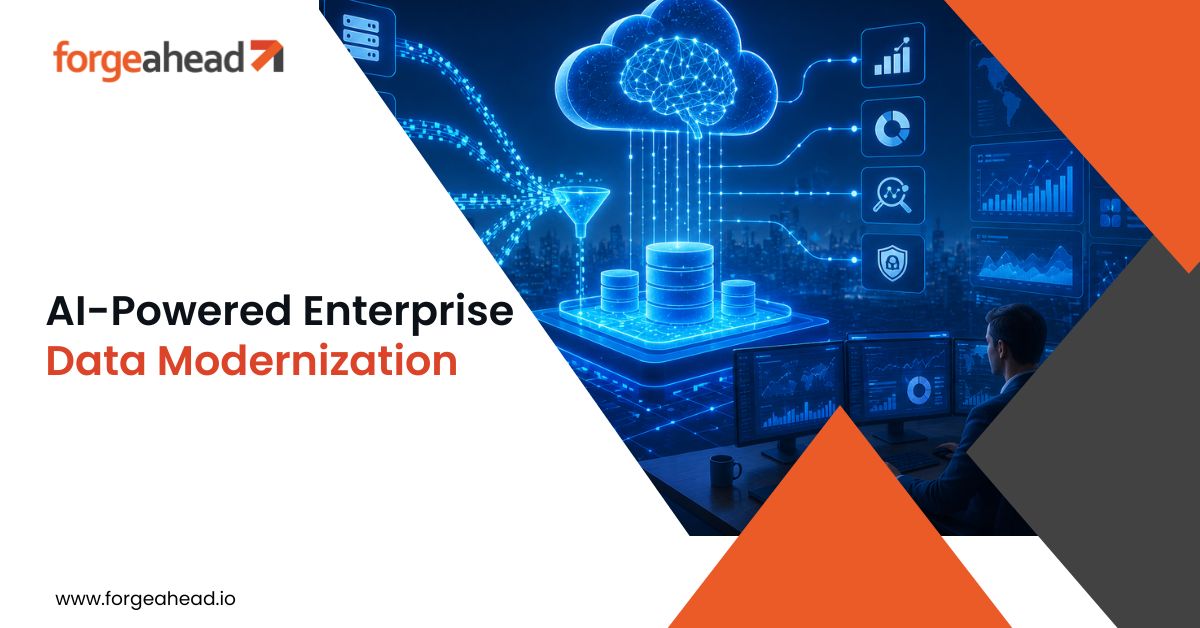
Meeting current demands calls for an AI-driven data architecture. This approach goes well beyond hosting data in the cloud. It focuses on creating a setup where data moves smoothly into cloud-based AI platforms, thus, supporting faster decisions that rely on live intelligence instead of delayed reporting.
How can Organizations Modernize Legacy Data Infrastructure?
Modernizing enterprise data architecture with cloud-based AI platforms starts with rethinking how data is stored, processed, and governed. Legacy setups often slow down access and limit flexibility, so the approach needs a fresh design built around cloud-based AI platforms. Here are the core approaches to make that transition work:
1.Replace Siloed Systems with Unified Data Platforms
Legacy architectures often rely on disconnected databases and brittle pipelines that are built for specific departments. This setup limits visibility across the organization and makes it harder to connect information across functions.
Modernization brings unified platforms such as data lakes or lakehouses that act as a single source of truth for analytics and AI. Data in the cloud, whether centralized or federated, then becomes easier to access and use. High-quality data becomes available to any model or application that needs it, which reduces the dependence on isolated systems.
- Build Cloud-Native, Scalable Data Pipelines
Modern data systems must match the speed of the business. Traditional batch-heavy processing, which often takes hours or days, is being replaced by real-time and streaming pipelines.
Using cloud-native services for ingestion and orchestration allows for a high degree of elasticity. Whether processing a few records or a massive surge during peak hours, your pipelines should automatically scale to meet the workload without manual intervention. This ensures that the insights fueling your AI models are always current and relevant.
- Integrate AI/ML Directly into Data Architecture
A frequent mistake is treating AI as a layer added after data processing is complete. In modern architecture, AI and machine learning work directly inside data pipelines.
ML models placed at ingestion and transformation stages handle tasks such as anomaly detection, predictive forecasting, and personalized content delivery as data flows through the system. This AI-native approach makes intelligence part of the data flow itself instead of a separate step.
- Enable Data Governance, Security, and Compliance by Design
Modernization without governance is a liability. As data becomes more accessible and autonomous, the risks associated with privacy and regulatory compliance increase.
Enterprises must implement governance frameworks and access controls that are embedded into the architecture from day one. This includes automated auditing and secure data flows to ensure that AI usage remains compliant with global standards. Strong governance doesn’t slow down innovation; it provides the safety rails that allow it to scale with confidence.
- Migrate and Modernize Legacy Tech Stacks
True modernization does not come from moving monolithic systems into the cloud. It calls for rethinking the tech stack and stepping away from outdated languages and frameworks in favor of modular, cloud-native designs.
Legacy applications often get refactored into microservices, supported by modern orchestration tools. A phased, risk-managed migration helps keep critical business functions running while the underlying systems evolve into a more flexible and resilient setup.
- Leverage Agentic AI for Continuous Optimization
The next stage of data architecture development brings in systems that act with greater autonomy instead of just executing automation rules. Agentic AI refers to specialized agents that observe conditions, reason through issues, and take action on their own.
Within data architecture, these agents monitor data pipelines for performance bottlenecks and suggest optimizations. They also assist in refactoring code and updating legacy scripts, which helps maintain modern standards. Cloud resources get adjusted automatically to improve cost and performance efficiency. The result is an adaptive system that keeps improving without constant manual intervention.
How Forgeahead Helps Modernize Core Systems
Forgeahead acts as a specialized engineering partner for organizations ready to re-architect their legacy systems for an AI-driven world. We focus on deep software modernization and tech stack migration, moving beyond simple infrastructure changes to create truly cloud-native environments on AWS.
With a product engineering mindset and a strong foundation in DevOps, we enable the integration of cloud-based AI platforms and the development of agentic AI solutions. Our approach ensures that your data architecture is secure, scalable, and reliable. Forgeahead helps platform builders and service providers modernize their core technology, ensuring they are production-ready for the demands of modern enterprise intelligence.
Conclusion
Modernizing enterprise data architecture is not a one-time migration. It involves continuous improvement toward cloud-native systems that work closely with AI capabilities. Strong engineering practices, scalable architecture, and secure implementation shape how well this holds together over time.
Replacing rigid silos with modular systems that can adjust and optimize on their own helps create a stronger data foundation. That foundation supports current needs and stays ready for new developments as they come.
Build a data foundation that supports innovation. Connect with Forgeahead to begin the move toward a modernized, AI-ready data architecture.
Frequently Asked Questions
- What is the difference between a data lake and a data lakehouse?
A data lake stores raw data in its original format, while a data lakehouse combines that flexibility with structured management and ACID transactions from a data warehouse. - How long does it take to modernize enterprise data architecture?
Timelines vary based on system complexity, but most enterprises approach modernization in phased stages to keep core operations stable while updates are applied. - Does agentic AI replace data engineers?
Agentic AI supports data engineers by handling repetitive monitoring, tuning, and refactoring tasks while engineers focus on design and architecture decisions. - What are the biggest risks of legacy-to-cloud migration?
Key risks include data loss during transfer, unexpected cost spikes from poor optimization, and security gaps when governance is not built in early. - How does AI help with data quality?
AI improves data quality by detecting duplicates, fixing formatting issues, and flagging outliers during data ingestion.